
The Artisan’s Advantage
How VFX expertise paired with machine learning solved a 30-year-old industry bottleneck

Every pixel at the edge of a green screen shot is a lie. When an actor’s hair catches the light in front of a chroma backdrop, or a sword blade reflects the green behind it, or a cloak blurs across the frame, the camera records a single color that is actually two colors mixed together: the foreground subject and the green background, blended at the sub-pixel level. The job of a chroma keyer is to undo that mixture, to recover the original foreground color and determine how transparent each pixel should be.
The tools available to do this have relied on essentially the same color-subtraction math for thirty years. They work well enough on clean edges against evenly lit screens and fail everywhere else. Motion blur, translucent materials, fine hair, refractive objects like glass: all produce mixed pixels that conventional keyers cannot cleanly separate. The standard professional workflow involves hours of manual masking, edge refinement, and despill correction per shot, and at the scale of a production requiring hundreds of composites, that labor becomes the single largest bottleneck between filming and creative work.
AI-based rotoscoping tools, which have proliferated over the past two years, solve a related but different problem. They identify where a subject ends and the background begins with impressive accuracy, generating masks that separate foreground from background, but those masks are binary: a pixel is either foreground or it isn’t. The semi-transparent information that makes motion blur look like motion blur and hair look like hair rather than a hard-edged cutout gets destroyed. For professional compositing, a binary mask is often only the starting point. The transparency data is what makes a composite look real.
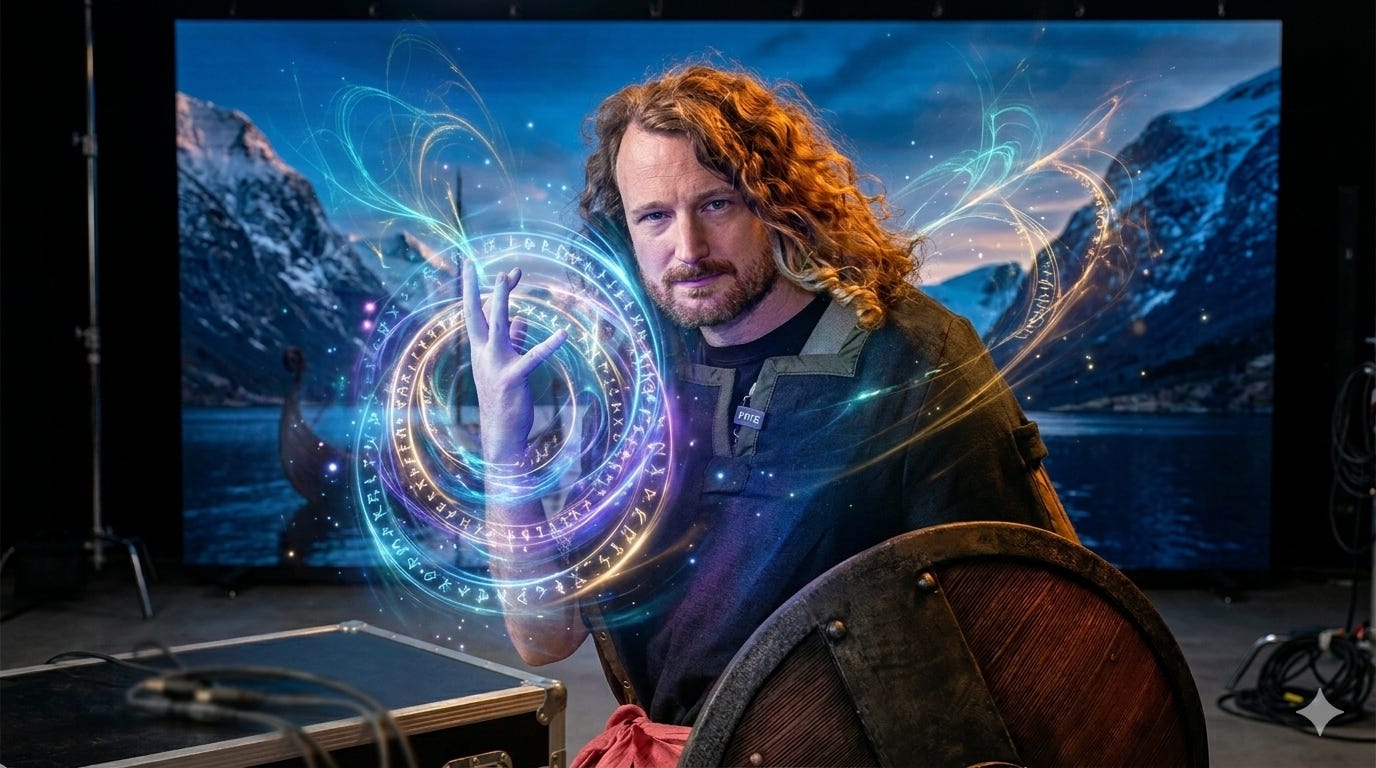
CorridorKey, released this past weekend by Corridor Digital co-founder Niko Pueringer, uses a neural network to predict, for every pixel in a green screen frame, both the true foreground color and a continuous alpha (transparency) value. The output reconstructs what the camera would have recorded if the green screen had been genuinely transparent: semi-transparent pixels retain their partial values, motion blur remains intact, and the green contamination in hair and reflective surfaces gets separated out mathematically rather than smeared away by a despill filter.
Trained by Experience
Corridor Digital is currently producing Season 3 of Son of a Dungeon, a tabletop RPG show requiring hundreds of green screen composites fed through a real-time relighting pipeline. Pueringer had been keying green screen shots since high school using the same fundamental tools, and the prospect of doing it again at this scale prompted him to build something new. When he mentioned the project to Joe Letteri, four-time Oscar-winning VFX supervisor at Wētā FX, Letteri’s response was blunt: Wētā had been trying to solve the same problem for years.
The training methodology is where the approach gets clever. Real green screen footage cannot provide mathematically perfect ground truth, because nobody knows exactly what the foreground color should be at each semi-transparent pixel. Pueringer sidestepped this by rendering all training data in CGI. Jordan Allen built a procedural generation system in Houdini that randomizes objects, materials, lighting, and camera parameters to produce thousands of scene variations automatically; interns Shane and Lucas built parallel systems in Blender for character and hair work. Because every scene is rendered, the foreground color and alpha channel are known with mathematical precision, giving the neural network unambiguous ground truth to learn from.
One training detail addresses the green fringe problem that has haunted conventional keyers for decades. During training, Pueringer recomposites the model’s predicted foreground and alpha outputs onto randomly colored backgrounds, including neutral gray. Any residual green contamination in semi-transparent pixels, invisible when composited back onto green, becomes obvious against orange or gray or blue. The model learns to eliminate green fringe entirely, because it cannot hide.
In the release video, Pueringer showed his Corridor Digital colleagues test shots that were already composited using CorridorKey without telling them. The shots included hair with heavy green spill, a reflective sword, chain mail, out-of-focus elements, motion blur, and a shot filmed through glass. None of them noticed the composites until Pueringer revealed the trick. Sam Gorski, Corridor Digital’s co-founder, assessed them as among the best keys ever produced in their studio.
The Final Pipeline
CorridorKey requires two inputs: the raw green screen footage and a coarse “alpha hint,” a rough mask indicating approximately where the foreground is. Bundled tools (GVM and VideoMaMa) can auto-generate the hint, or users can supply their own from any AI roto tool. The model outputs separate foreground color, alpha matte, and premultiplied composite in 16-bit and 32-bit EXR format for direct integration into Nuke, Fusion, or DaVinci Resolve, and a built-in morphological cleanup system removes tracking markers and small background artifacts automatically.
The hardware floor is high: running inference at 2048×2048 requires approximately 22.7 GB of VRAM, which limits local execution to 24 GB GPUs (an RTX 3090, 4090, or 5090) or better. The optional GVM alpha hint generator needs roughly 80 GB. Cloud instances on services like RunPod cost under a dollar an hour for those without local hardware. The tool ships under a CC BY-NC-SA 4.0 license, free for non-commercial use, with derivatives required to remain open source.
The professional VFX community responded with unusual speed. Within hours of the GitHub release, cnoellert on the Logik Forums had built working ComfyUI nodes for the tool. A community-contributed MLX port for native Apple Silicon support has since been merged into the main repository, and MPS (Metal Performance Shaders) support for Mac GPUs followed shortly after. One tester on the Logik Forums processed 115 frames of 5K footage, downscaled to roughly 2K for inference, on an M4 Max MacBook Pro in twenty minutes. Given the sharp criticism that Corridor Digital faced in response to their AI-generated anime shorts in 2023, the speed of adoption is striking. Gorski put it simply in the release video: the purpose of these tools is to skip the mechanical labor so that the artist arrives at the creative stage, making decisions about lighting, atmosphere, and composition, without hours of grunt work in between. Generating the final image by machine skips the creative stage too, which defeats the point. CorridorKey eliminates despill correction and edge refinement while leaving the compositing itself untouched.
Artificial Intelligence, Human Excellence
There is nothing exotic about the neural network architecture underlying CorridorKey. Two decades of compositing experience shaped every decision around it, from training on CGI to produce mathematically perfect ground truth, to the recompositing trick that forces proper color unmixing, to the choice of professional EXR output with separate foreground and alpha channels rather than a flattened composite. Each of those decisions reflects knowledge that only comes from having spent thousands of hours fighting the specific failures of conventional keyers. The generic AI roto tools built by large engineering teams produce impressive demos but miss the semi-transparency problem entirely, because their builders have optimized for segmentation accuracy rather than compositing fidelity.
Domain knowledge of that kind is increasingly the determining factor in whether an AI tool actually gets adopted. Pueringer understood the problem at a level of specificity (green fringe in semi-transparent edge pixels, tracking marker removal, the need for linear alpha in float-point EXR) that allowed him to design training data and loss functions targeted at the exact failures practitioners encounter daily. The result is a tool that professional compositors recognized on sight as solving their problem, rather than a technology demo that approximates it.
Pueringer has indicated he will release the training code and datasets if community demand warrants it, opening the door for fine-tuned models trained on specific shooting conditions. The repository already includes documentation structured for AI coding assistants, anticipating collaborative development from a community that has already proven, within days of release, that it intends to show up.
"Motion blur, translucent materials, fine hair, refractive objects like glass: all produce mixed pixels that conventional keyers cannot cleanly separate."
Dark Herald posted about this problem and the ingenious solution Disney used to solve it for Mary Poppins in the 1960s. Like losing the tech to land on the moon, but for real haha. It was very complex and expensive and only a few working prototypes were ever constructed.
Check out this cool video: https://www.youtube.com/watch?v=UQuIVsNzqDk