
Your $20 race engineer
How AI racing coaches benefit from the perfect telemetry generated by racing simulators.

Sim racing has moved well past the plastic steering wheel clamped to a desk. Platforms like iRacing host organized leagues with more than 350,000 subscribers, complete with qualifying splits, championship points, and scheduled events that reproduce the structure of professional motorsport. An estimated 190 million people play racing games on console and PC each month, and the most committed segment has graduated to simulation-grade hardware that costs thousands of dollars. You can spend hundreds of hours learning a track, shaving tenths off your lap time through instinct and repetition, and still reach the wall where more practice produces no measurable improvement. The traditional next step was to hire a professional driving coach at $200 an hour, or to upload telemetry to a shared folder and wait for feedback. A new category of AI coaching tools has replaced both options at a fraction of the cost.
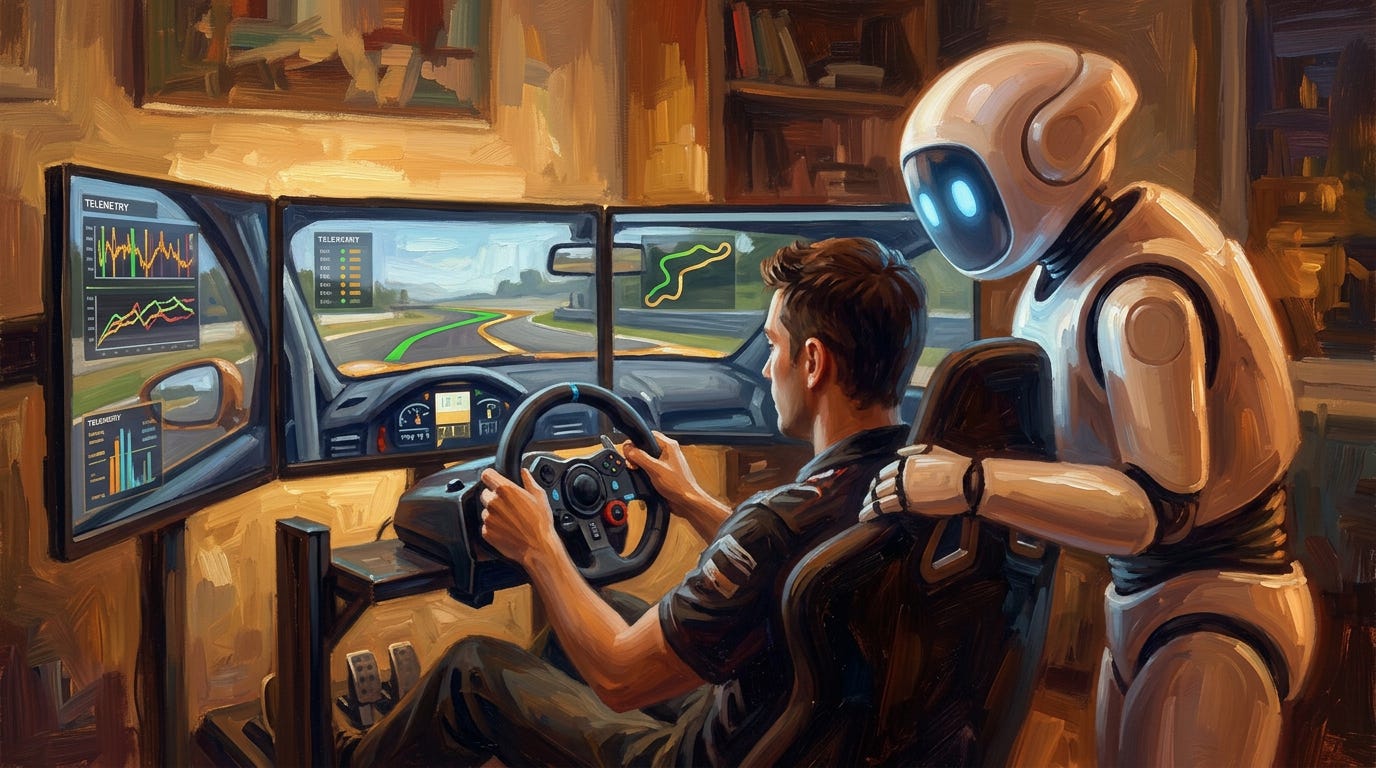
Perfect insight
A racing simulator logs every driver input at the source. Braking pressure, throttle position, steering angle, vehicle speed, gear selection, and the exact racing line through each corner all arrive as structured digital data, captured directly from the software that generated the driving experience. The telemetry updates hundreds of times per second and requires no camera angles, no sensor calibration, and no interpretation. An AI coach reading this data knows the car’s behavior as precisely as the simulator’s physics engine, because the data comes from that engine.
This data completeness gives AI coaches an advantage in sim racing that no other hobby can match. A running coach app works from GPS traces and wrist-mounted accelerometers, inferring gait from proxy measurements. A golf swing analyzer captures one camera angle that software must interpret. In a racing simulator, the AI accesses the same information that the physics engine used to model the car, precise and complete at every millisecond. This fidelity allows an AI tool to correlate steering angle with braking point and exit speed across hundreds of laps, identifying patterns that even an experienced human coach would struggle to track in real time.
Corner by corner
The earliest AI coaching tools for sim racing worked as comparison engines. Virtual Racing School overlays your telemetry against a professional driver’s reference lap, showing precisely where you brake later, carry less speed, or take a wider line. You can stack speed traces from your last twenty laps against the reference and watch your braking point drift through a sequence of attempts. At $5 to $10 per month, VRS gives you the data to find your own gaps, but closing them remains your job.
The coaching tools that have emerged over the past two years go a step further. Coach Dave Delta’s Auto Insights feature, built around professional racing driver David Perel’s coaching methodology, decomposes each corner into four phases in real time and identifies where time was lost at braking, entry, apex, or exit. It might report that your apex speed through a particular corner ran five kilometers per hour below the reference. Track Titan’s Coaching Flows isolate the single biggest mistake on each lap and walk the driver through a specific correction, quantifying the time cost so you know which corners to attack first. trophi.ai delivers live voice coaching during the session through its “Mansell” AI, calling out adjustments while you drive. These tools cost between $8 and $20 per month, and the category has attracted serious investment. Track Titan raised $5 million with backing from investors that include Porsche, and the platform counts over 285,000 users.
Good enough for the pros
The skills that these tools sharpen transfer beyond the screen. The Gran Turismo Academy proved the concept more than a decade ago, when Jann Mardenborough beat 90,000 competitors in 2011 to earn a professional Nissan racing contract, a story that the 2023 film dramatized for a mainstream audience. Track Titan’s founder Max Teichert followed the same trajectory, from Gran Turismo Academy finalist to Porsche driving coach. F1 driver Kimi Antonelli now trains on a bespoke home simulator built to replicate his Mercedes F1 car, and Max Verstappen races online the night before Grand Prix weekends. A driver who once needed a professional coach to decode telemetry can now receive that analysis automatically with every session. The braking points, throttle curves, and racing lines that AI coaches optimize in a simulator are the same inputs that determine lap times on asphalt.
Data must come first
The racing simulator market reached $1.3 billion in 2026 and grows at 8.3 percent annually, driven partly by the coaching and analytics ecosystem that surrounds it. AI coaching succeeded in sim racing first because the simulator solved the data problem before anyone posed the coaching problem. Every driver input passes through software that records it perfectly. Other sports will spend years building the sensor infrastructure to approach that data fidelity, and the coaching tools will follow wherever the data goes.