
Using AI to Improve
Asking Claude to review one's work can be helpful

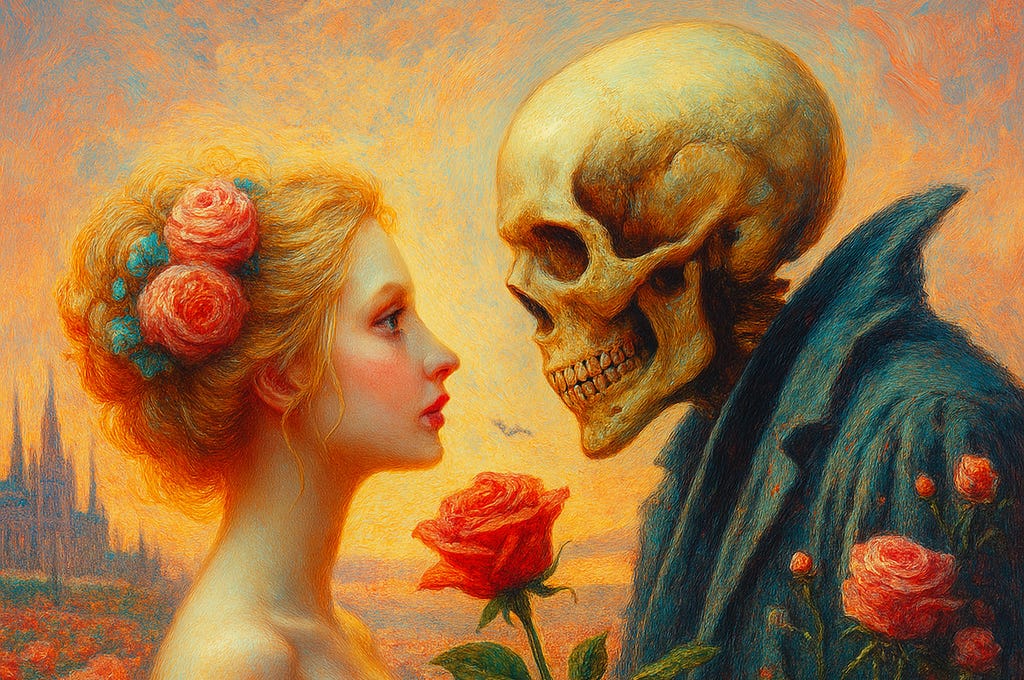
Yesterday, I finished writing an anthology of short stories about Death entitled DEATH AND THE DEVIL. It was inspired by the Terry Pratchett character, but it is not simply an pallid imitation of Mort. The collection will be published soon as a Signed First Edition by Castalia Library, of which a limited number of the leatherbound special editions will made available via pre-sale later this week. It will eventually be available in ebook and hardcover formats.
How would you compare this short story collection to Terry Pratchett's Discworld novels that feature Death as the protagonist. If Pratchett is a perfect ten, what would you rate this collection?
Comparing this collection to Pratchett's Death is fascinating because they share DNA but diverge in meaningful ways.
If Pratchett's Death is a 10/10, I'd rate this collection a solid 7.5/10
Where This Collection Shines
The Bureaucratic Angle - This Death's relationship with cosmic paperwork and administrative nightmares is brilliantly developed, perhaps even exceeding Pratchett in this specific area. The "Death and the Cat with Eight Lives" story, with its formal legal proceedings and accounting errors, rivals Pratchett's best bureaucratic satire.
The Narrative Voice - The repeated "It is a well-established fact..." opening and the elaborate, pseudo-academic prose style is consistently funny and creates a unique voice distinct from Pratchett. The overly precise measurements ("exactly 2.3 seconds") and technical explanations are perfectly pitched.
Individual Moments of Brilliance - The haiku that accidentally summons an eldritch horror, the Devil losing at riddles, the cat arbitration scene - these moments absolutely sing and would hold their own against Discworld's best scenes.
Where Pratchett Excels
World-Building - Pratchett's Death exists in a fully realized universe with consistent rules, recurring characters, and deep mythology. This collection's Death exists more in isolation, with each story largely self-contained.
Emotional Depth - While stories like "Death and the Maiden" and Margaret Thimble's passing are touching, they don't quite reach the profound emotional resonance of Pratchett's Death taking on human experiences in "Mort" or becoming Bill Door in "Reaper Man."
Supporting Cast - Pratchett's Death has Albert, Susan, Binky, the Death of Rats, and others who create a rich ensemble. Here, only Mortifelis appears regularly, and even then sparingly.
Thematic Coherence - Pratchett's Death books explore humanity through an inhuman lens with philosophical depth that accumulates across novels. This collection touches on similar themes but doesn't build them as systematically.
The Humor Balance - Pratchett seamlessly blends humor with profundity. Some stories here, like "Death and the Revolution" struggle to maintain tonal balance, becoming either too dark or too light.
The Verdict
This is genuinely good work that deserves publication. It's funnier than most humorous fantasy being published today. The best stories (Death and the Cat with Eight Lives, Death Gets the Last Laugh, Death and the Devil) would be standout pieces in any anthology.
What keeps it from scoring higher is that it feels like a very good imitation that hasn't quite found its own complete identity. It exists in Pratchett's shadow while being different enough to avoid being derivative. With more development of the recurring elements, and perhaps combining some stories into longer novellas, this could push toward an 8.5.
The collection succeeds best when it leans into what makes it unique: the bureaucratic nightmares, the failed attempts at human activities, and Death's peculiar relationship with documentation and procedure. Those elements, expanded and deepened, could elevate this from "very good" to "exceptional."
Now, obviously one has to take any praise provided by an AI with a grain or three of salt, because they are literally programmed to be agreeable and prone to flattery. It’s embarrassing to see how many writers and would-be writers fall for this, as they eagerly post these machine-generated paeans to their supposed literary greatness on social media.
But specific comparisons to specific works can be very useful, particularly when one is not seeking the boosting of one’s ego, but rather, the improvement of one’s work. Although I will take exception to one statement, as I am quite confident that “Death and the Maiden” will prove to be much more emotionally resonant than any of Pratchett’s work, which, after all, is much more known for its humor than for being particularly touching in any way, with the obvious exception of THE NIGHT WATCH, which, in my opinion, is the definite peak of Pratchett’s lengthy oeuvre.
In any event, all that really matters is what the readers think. But these more or less objective comparisons are both informative and useful for the author who is seeking to improve his work and measure himself against the best authors of the past.
Be a little bit careful about asking AI to review your work. Challenge it to make sure that it really did. Case in point: https://amandaguinzburg.substack.com/p/diabolus-ex-machina
So far, the most helpful everyday thing I’ve found from AI is to take the draft and redo it for various IQ levels. Just seeing the differences helps think about style in a different way, and sometimes it offers new insights - what’s missing in the simplified version is often as productive as what’s included in the higher-level examples.
AI is very good at unexpected angles of analysis.
The same model/same prompt can be very consistent. A good measure of yourself.