
The Tabletop Paradox
The tabletop RPG industry has drawn a hard line against AI, but players are quietly embracing it anyway.

A common joke in tabletop RPG communities holds that the true final boss of any campaign is scheduling. Adults with jobs and families and obligations discover that coordinating four to six people for a few hours of pretending to be elves is, in practice, brutally difficult. Campaigns die not from dragon fire but from calendar conflicts.
This mundane reality sits at the center of a growing tension within the tabletop roleplaying community, one that reveals something interesting about how different constituencies within the same hobby can arrive at radically different conclusions about artificial intelligence.
The publishing side of tabletop gaming has drawn its line with unusual clarity. A year ago, the ENnie Awards announced that beginning with the 2025-2026 submission cycle, products containing any generative AI content would be ineligible for consideration. The ENnies, awarded annually at Gen Con and widely regarded as the most prestigious honors in tabletop RPGs, had previously allowed AI-containing products to compete as long as the AI-generated portions themselves weren’t the basis for the award. Community feedback made clear this wasn’t enough.
The revised policy reflects a broader industry consensus. Chaosium banned AI content in December 2022. Paizo followed in March 2023. Free League, Modiphius, and numerous smaller publishers have issued similar declarations. When White Wolf posted job listings last summer that asked applicants about their experience with AI tools, the backlash was swift enough to prompt a clarifying statement.
The arguments against AI in published products are familiar: generative AI training on copyrighted work without compensation, the threat to artists and writers who have built the visual and narrative language of the hobby, the environmental costs. But TTRPG publishers tend to frame their opposition in terms specific to the medium. As one publisher told Wargamer, these games are fundamentally about telling and sharing human stories. The connection between creator and player matters in a way that feels distinctive to the hobby.
Wizards of the Coast, the industry’s dominant player through its ownership of Dungeons & Dragons and Magic: The Gathering, has maintained an official policy banning AI in the creation of final products for both properties. The policy emerged after a 2023 incident in which AI-generated art appeared in the sourcebook Bigby Presents: Glory of Giants, prompting fan outcry and artist boycotts. Wizards has since invested in AI detection tools to prevent recurrence.
Yet the official policy exists in tension with the stated views of Hasbro CEO Chris Cocks, who told Semafor in March 2025 that he personally uses AI to generate storylines, artwork, and even character voices for his own D&D games. Cocks noted that among the 30 to 40 people he plays with regularly, not a single one doesn’t use AI somehow for campaign or character development. At a Goldman Sachs conference the previous year, he suggested D&D’s fifty years of content represented a trove the company could mine using AI systems.
The dissonance is instructive. What Cocks describes is not the use of AI in commercial products but in private play, the actual sessions where people gather around tables or screens to tell stories together. And here the picture looks quite different from the industry’s public stance.
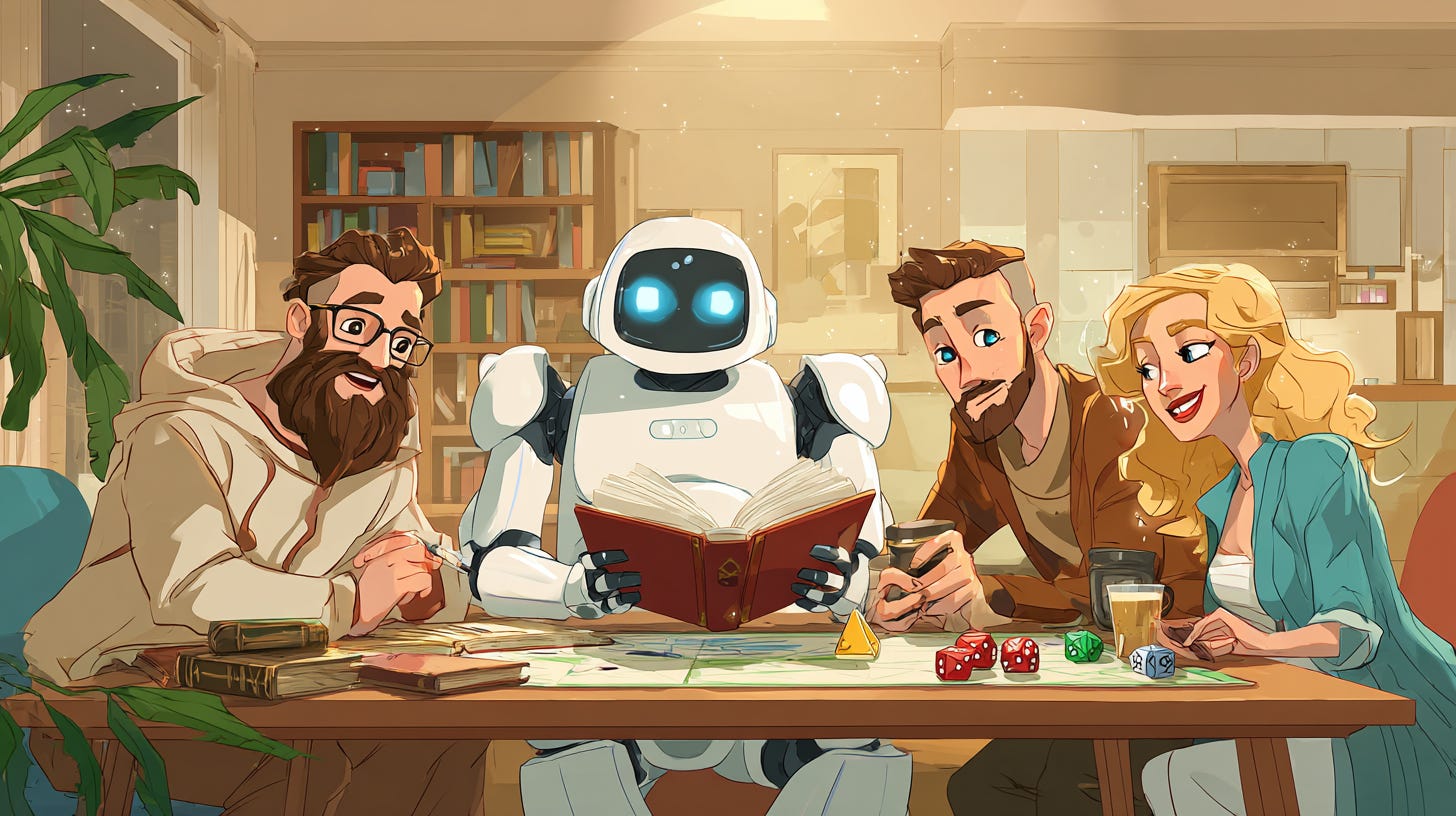
Solo tabletop RPGs have grown from a niche curiosity into a significant segment of the hobby. The pandemic accelerated interest that had been building for years, as players discovered they could scratch the tabletop itch without solving the scheduling problem. Games like Ironsworn, a dark fantasy RPG built from the ground up for solo play and available as a free download, won ENNIE gold and developed devoted followings. Journaling games like Thousand Year Old Vampire found audiences who wanted narrative depth without social coordination.
Traditional solo play relies on oracles, random tables, dice rolls, and the player’s imagination to simulate the surprises a human game master would provide. One makes choices, consults the oracle, interprets the results, and writes the story. It works, but it requires the player to shoulder the cognitive load of both protagonist and narrator, both character and world.
AI changes this equation. Platforms like Friends & Fables, AI Realm, and MythEngyn offer AI game masters that run campaigns based on D&D 5th Edition rules, track inventory and character progression, generate NPCs and locations, and respond dynamically to player choices. Friends & Fables supports multiplayer campaigns where an AI named Franz manages the story even when players drop in and out asynchronously, solving not just the scheduling problem but the game-master-availability problem.
The value proposition is straightforward. As one user review on EN World put it: “AI Realm is perfect for when I need my DND fix but my dungeon master or other players aren’t available.” Another noted the platform was “way better than AI Dungeon was last time I tried it.”
These tools matter most for people outside the hobby’s traditional core. The assumptions embedded in tabletop RPGs, weekly sessions with a stable local group, a GM who has time for substantial prep, access to game stores and conventions and a critical mass of fellow enthusiasts, reflect a specific demographic reality: Western, urban, with disposable time and a pre-existing gaming culture. If one lives in a smaller city, or a country where tabletop gaming never developed the same infrastructure, or simply in a place where English-language rulebooks aren’t readily available, the standard advice to “just find a group” has always rung hollow. Many of the hobby’s most engaged enthusiasts, the people who buy books and read systems and follow actual-play podcasts, have historically struggled to do the thing the hobby is nominally about.
Beyond dedicated platforms, a cottage industry has emerged around using general-purpose AI tools for tabletop play. Blog posts and guides explain how to prompt ChatGPT or Claude to run NPCs, generate setting details, or unstick moments where narrative momentum has stalled. The advice tends toward the practical: AI won’t make creative decisions for you, but it will give you material to react to. Use it to handle the busywork so you can focus on playing.
The December 2025 LitRPG Reads analysis of AI ethics in D&D called the question “perhaps the single most volatile topic in the tabletop community right now.” The piece drew a distinction that often gets lost in broader debates: the ethical calculus for AI in commercial publishing differs from that for private, non-commercial home games. What publishers sell and what players do at their own tables are different things.
The tension here isn’t really about technology. It’s about what tabletop roleplaying is for.
The publishing industry’s position treats TTRPGs as a creative ecosystem built on human connection, where artists and writers and designers sustain both the products and the visual vocabulary that players internalize. From this view, AI represents extraction: taking the accumulated work of human creators to produce something that competes with and devalues their labor. The TTRPG community art scene is intimately tied to identity and representation, with players commissioning art precisely because they want to see characters that don’t exist in official books.
The player perspective can accommodate this concern while adding another: tabletop RPGs exist to be played, and anything that makes play more accessible expands the hobby. For the parent who can’t commit to a weekly game night, the socially anxious person who struggles to find a group, the shift worker whose schedule never aligns with potential party members, AI tools offer a way in. Solo RPGs are not a consolation prize for people without groups but a full, rich way to experience collaborative storytelling on one’s own terms.
The market data suggests both constituencies are growing. The TTRPG market was valued at roughly $2.15 billion in 2025 and is projected to triple by 2035, with digital platform adoption at 48% and growing. Solo play has expanded from pandemic-era experimentation into a permanent feature of the hobby, with publishers like Shadowdark now releasing dedicated solo versions of their games.
What’s notable is that this isn’t a conflict between publishers and players so much as between two different activities that happen to share a name. Publishing a sourcebook and playing a Tuesday night campaign are related but distinct. The former involves commercial transactions, artist compensation, and industry norms. The latter involves friends, imagination, and whatever tools help the story come alive. A player using AI to generate a tavern description isn’t taking work from an artist any more than someone doodling their character on scratch paper is.
The publishers understand this, even if they don’t say it explicitly. The ENnie Awards ban applies to products submitted for consideration, not to how people run their home games. Wizards of the Coast’s policy governs what artists and writers contribute to official books, not what players do with those books afterward. The line is drawn around commerce, not play.
Chris Cocks, for all the criticism his comments attracted, was describing something unremarkable: hobbyists using available tools to enhance their hobby. The concern is that corporate ownership might eventually push AI into commercial products despite community resistance, that the CEO’s personal enthusiasm might translate into policy. That’s a legitimate worry given Hasbro’s history of squeezing value from its properties.
But the broader phenomenon, players quietly adopting AI tools while publishers loudly reject them, isn’t hypocrisy. It’s two different conversations happening in parallel. The publishing conversation is about labor, compensation, and the ethics of generative AI training. The play conversation is about accessibility, scheduling, and getting one’s D&D fix when the party isn’t available.
Both conversations matter. Neither invalidates the other. And the hobby is large enough to contain the tension.
For publishers, the ENnies, and the official products sitting on game store shelves, the line against AI seems likely to hold, at least for now. The community has spoken clearly, and the business incentives align: TTRPG buyers care about human creativity in ways that other consumer markets may not.
For players, the picture is messier and more interesting. AI game masters aren’t replacing human dungeon masters; they’re enabling play that wouldn’t happen otherwise. The person on a Tuesday night who can’t find a group, the parent stealing twenty minutes during naptime, the enthusiast in a country where the local gaming scene barely exists: these people were never going to have traditional campaigns anyway. AI gives them something where before they had nothing.
The scheduling boss remains undefeated. But at least now there’s a workaround.
"The community has spoken clearly, and the business incentives align: TTRPG buyers care about human creativity in ways that other consumer markets may not."
The real trouble here is art. It is *expensive* to do good art for a book the old-fashioned way, and it eats up a lot of any Kickstarter budget. Autarch (of ACKS II fame) was lucky in making a sizeable six-figure number for ACKS II, but if you don't have that kind of money, AI is getting increasingly tempting. I suspect it's only a matter of time before the dam breaks.
Bradford Walker's Clubhouse will come to pass, while the Industry slowly, then rapidly, becomes a black hole of gachapon phone games.
AI and the Clubhouse will get along just fine.