
The Shutdown of Sora
The AI investment bubble is ending

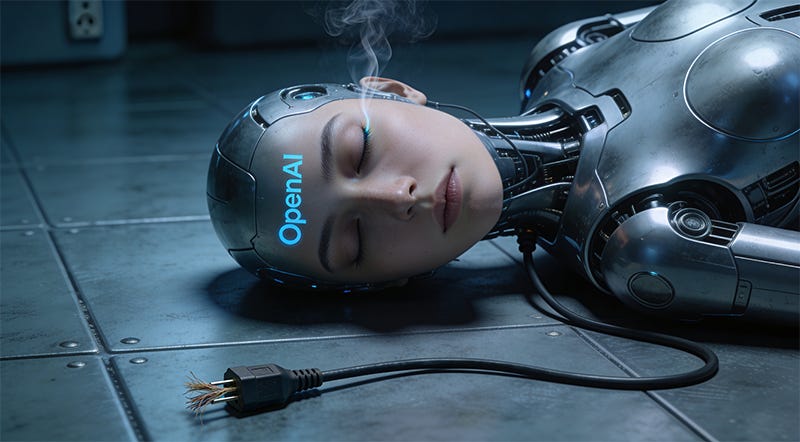
OpenAI shut down its video-generation system, Sora, last week:
OpenAI has unexpectedly shut down Sora, its generative AI video model. Despite a surge of initial popularity, the tech was dogged by controversy and copyright issues and proved prohibitively expensive.
In a significant blow to OpenAI, a $1 billion December 2025 deal to allow Sora users to generate AI videos featuring Disney characters was canceled at the same time Sora was jettisoned.
The company gave no reason for the shutdown of Sora, although analysts point to the dismal economics. With AI in the midst of what has all the appearances of a bubble, many wonder if the downfall of Sora could be the beginning of the end, especially as the war on Iran pressures supply chains and drives energy costs higher…
The decision appears to have been driven by financial considerations as OpenAI looks to streamline operations in preparation for an initial public offering as early as this year.
The platform was extraordinarily expensive. In November, one analyst suggested that it cost OpenAI $1.30 to generate a single ten-second video. Based on the 11.3 million daily videos that he estimated Sora produced, the analyst said this would cost the company about $15 million every day.
Just a few weeks prior to that, Sora head Bill Peebles admitted that the platform’s economics were “completely unsustainable.”
According to Business Insider, there was another problem that is proving to be an intractable constraint across the AI industry: Computing power. Video generation is the most energy-intensive form of AI currently in use.
The fundamental problem is that with the exception of Anthropic, the other AI players all appear to be focused on driving up their stock values rather than building their AI businesses.
Anyone who actually uses AI for profitable purposes won’t hesitate to drop $100 or $200 on a subscription that pays for itself in the first week. The problem is that while there are enough of those people upon whom to build a solid, profitable business foundation, there aren’t enough of them to justify the inflated Wall Street expectations.
Hyperscalers raised $108 billion in debt during 2025. Morgan Stanley estimates borrowing will hit $400 billion in 2026.
So more than half of their spending on AI infrastructure is borrowed money. This means we can safely anticipate further shutdowns and shakeouts in the AI space. The good news is that the companies that survive will be providing better, more meaningful AI products for serious creators.
The $200 Pro subscription gave users 100 generations per day, and that's in addition to all the ChatGPT and Codex benefits. It's safe to say OpenAI was heavily subsidizing the cost in hopes it might turn into opportunities down the road. No other video generation AI offers that kind of value.
I'm in some groups with all the top creators from Sora, and we've known for some time the writing was on the wall. Sora has had serious user retention problems from the start. Basically they check out the platform for a day or two and leave.
No one I know even knew about the social network aspect to Sora until they checked it out. Perhaps if the execution and marketing had been better things would be different, but I'm doubtful given the points mentioned in this article.
It does not look like that a 200$ subscription would be enough.
A user can easily burn through tokens worth ten, hundreds or even thousand times more.
These kind of workloads are expensive and dont scale well. There might be a sweet spot somewhere but its not 200$ a month, far from it.
Usage based pricing would solve a lot of issues for the AI industry but that will be a tough sell.