
The Half-Solved Hobby
AI is delivering the consumer 3D printing that was promised, so long as the product does not require assembly.

The original pitch for consumer 3D printing promised a desktop machine that turned ideas into physical objects. The printers arrived and kept improving, but the pitch foundered anyway on two problems. Most people could not design the objects, and the machines failed too often when left unattended. In 2026, AI has addressed both. Text-to-3D generators handle the design step, and onboard neural networks watch the printer overnight. These fixes apply to figurines, props, and tabletop miniatures, the artistic half of the hobby where aesthetics matter and dimensions do not.
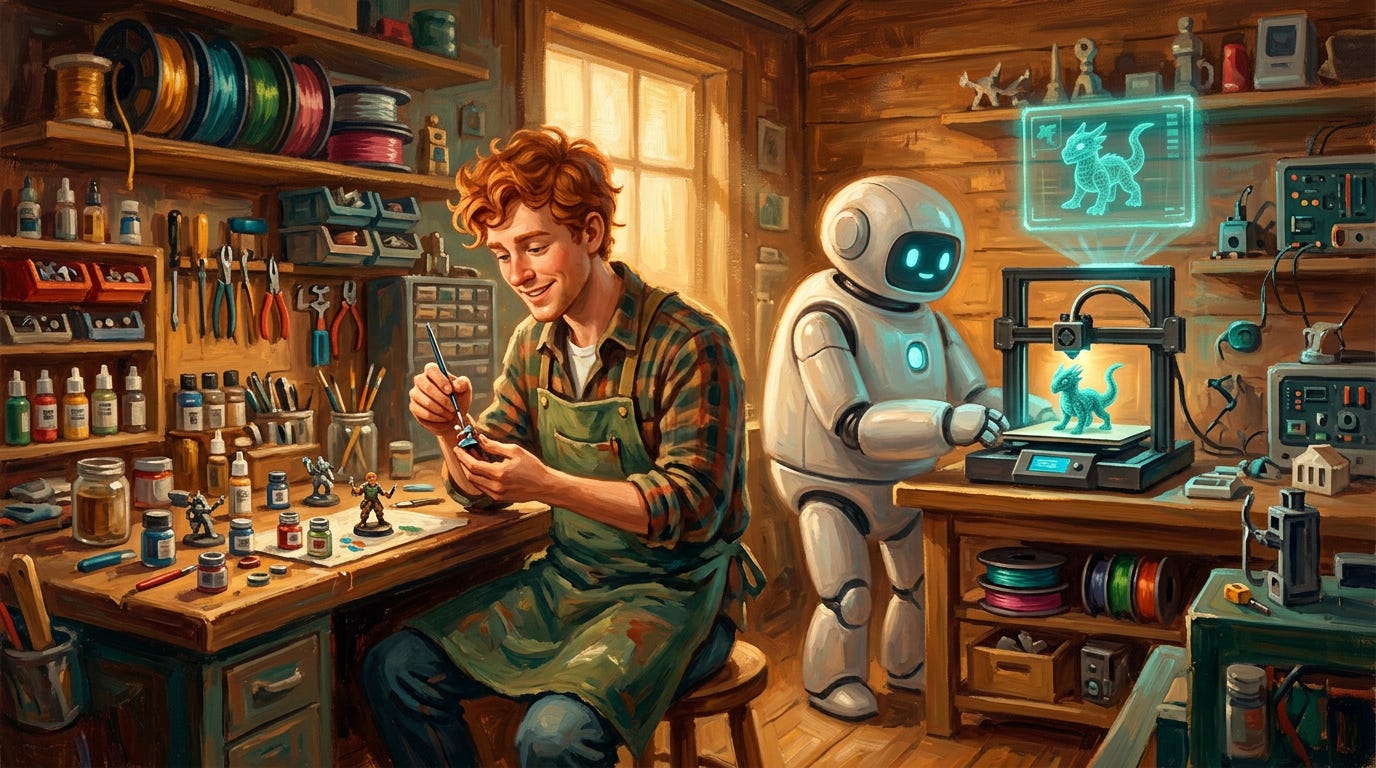
The modeler bottleneck
3D printing’s consumer promise stalled at the design step. The printers grew faster, cheaper, and more reliable over the past decade. Bambu Lab’s machines brought automatic calibration, enclosed chambers, and multi-material printing to a consumer price point. Making something worth printing, however, still required months of learning Blender, ZBrush, or Fusion 360. Most hobbyists skipped that barrier entirely and downloaded pre-made files from repositories like Thingiverse, which limited the hobby to printing other people’s ideas.
Meshy, a text-to-3D platform that launched in 2023, has since registered more than ten million users and generated over a hundred million models. You type a description or upload a photo, and the system returns a textured 3D mesh in about a minute. A partnership with Formlabs announced in April lets users send a generated model to a professional resin printer without exporting a file, and slicer plugins for Bambu Studio, OrcaSlicer, and Cura handle the consumer side.
The output quality has crossed a usability threshold for organic shapes. Meshy reports a 97% slicer pass rate on figurine models, and competitors like Hitem3D push resolution to 1536³ for resin-printed tabletop miniatures. Tripo adds automatic mesh repair before export. Nearly every AI-generated model still needs a cleanup pass to check wall thickness and seal non-manifold edges before printing reliably. That work takes minutes, and it replaces months of learning to sculpt from scratch.
Overnight supervision
The other longstanding barrier was reliability. A print that detaches from the bed or suffers a nozzle clog will extrude hours of filament into tangled waste, a failure mode that the community calls “spaghetti.” The longer the print, the worse the odds. An overnight job that fails at hour six wastes filament, electricity, and the time it takes to clean hardened plastic from the hot end. The only mitigation was a webcam and a light sleep.
Bambu Lab’s printers now run an object-detection neural network on an onboard NPU that analyzes camera frames every few seconds. The system accumulates results across ten consecutive frames and checks for spatial consistency before confirming a failure and pausing the job. The P2S model extends detection to foreign objects on the build plate, nozzle clogging, and first-layer adhesion problems. All processing runs on the device. The system struggles with dark filaments on dark build plates, and false alarms remain common enough that Bambu explicitly asks users to join an experience-improvement program that feeds detection data back to the training pipeline.
Obico, an open-source project that started as “The Spaghetti Detective,” provides the same capability for any printer running OctoPrint or Klipper. A Raspberry Pi, a USB webcam, and the Obico software give a five-year-old Creality Ender the same AI failure detection that Bambu builds into its premium machines. The project offers both a cloud tier and a fully self-hosted option, which means the entire monitoring pipeline can run without sending data to an external server.
Dimensions still matter
AI generators produce meshes optimized for rendering. A model that looks stunning on screen can fail on the print bed because its geometry lacks the dimensional precision and toleranced features that functional parts require. The generators have no concept of scale and cannot produce threads, snap-fits, or walls thin enough to flex on purpose. A bracket that must mate with an existing assembly or an enclosure that requires screw bosses at precise intervals still demands parametric CAD. Fusion 360 and FreeCAD remain the tools for that work, and AI has offered no shortcut to learning them.
Still a ways to go
AI has split 3D printing into two hobbies with different skill floors. On the artistic side, anyone who can type “elven wizard with a staff” into a text box can have a painted miniature on the shelf by the next morning. AI generates the model, checks the mesh, and monitors the print overnight. On the engineering side, a replacement hinge or a custom enclosure still requires the same parametric modeling skills and the same iterative test-print cycles that the hobby has always demanded. The two hobbies share a printer and almost nothing else about the workflow that feeds it.
Say the game designer wants builds for a board game or mini figs to complement a stretch goal for a digital one: Is this new service cost-effective?
And if yes, how will it hit indy gamers getting hammered by Corporate on one side, and the no-AI zealots on the other?
Now we just need an ai program with a robot arm that can paint the miniatures so they are ready to play!