
The Agentic Mailroom
AI email tools spent two years optimizing composition when triage was the real pain point.

Every major email platform now offers AI-assisted drafting, and for two years the interaction has followed the same pattern. The user opens a message, decides that a reply is warranted, requests a draft, and edits the output before sending. Gmail, Outlook, and a half-dozen smaller clients have all built some version of this workflow. The AI accelerates composition. The human initiates every step.
A new Superhuman feature reverses this sequence by writing the reply before the user opens the email. Its beta data suggests that this design choice has produced an accidental audit of professional email itself.
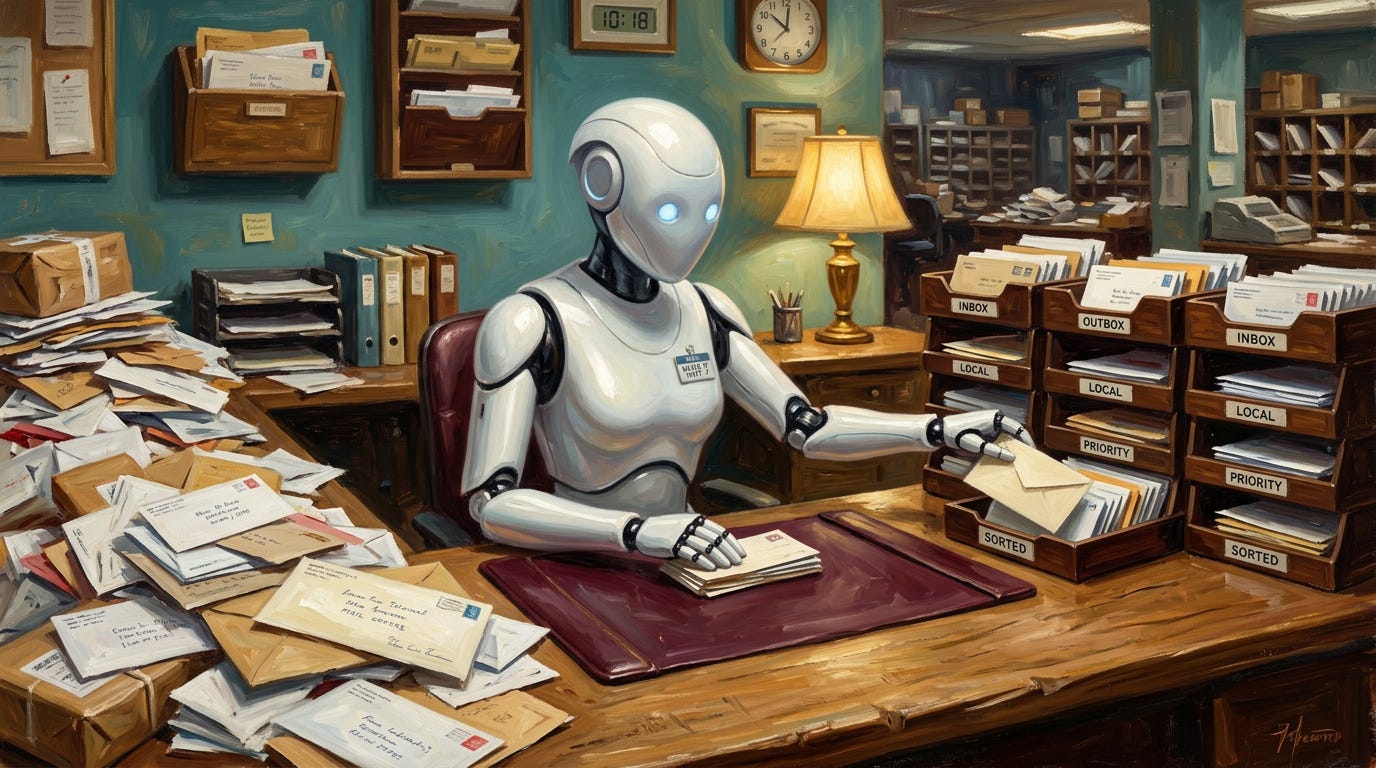
One step ahead
Superhuman launched a new auto-draft feature earlier this month that generates email replies before the user opens the message. The system uses frontier models from both Anthropic and OpenAI to read incoming messages, assess tone from previous conversations, and compose a draft with two alternative variations. Users can personalize the system by adding details about their role and responsibilities, giving the model additional context for which emails to draft and how to frame responses. During the beta period, co-founder Rahul Vohra reported that 40% of auto-generated drafts were sent within one day of creation, and that 60% of those went out without any manual editing.
The unedited drafts covered substantive professional exchanges. In TechCrunch’s hands-on testing, auto-generated replies confirmed embargo terms on press pitches, proposed meeting times from the user’s calendar, and redirected requests that fell outside the user’s responsibilities. The system also learned from corrections. After it agreed to a post-midnight meeting, subsequent scheduling drafts began declining similar time slots. These messages carry professional stakes, yet their content follows from context and convention. Given the sender, the subject line, and the preceding thread, a sufficiently capable model can infer the correct response.
Superhuman attempted proactive email drafting before. Vohra acknowledged that earlier versions, built on GPT-3.5, produced replies that sounded like an overly enthusiastic AI salesperson. The upgrade to frontier models with larger context windows and stronger tone calibration fixed the output quality without changing the feature’s architecture. The proactive design never changed. The models matured into it.
The wrong bottleneck
Gmail and Outlook took a different approach. Gmail’s Gemini integration, rolling out since January, added Help Me Write for prompt-based drafting, Suggested Replies that match the user’s writing style, AI Overviews that summarize long threads, and a Proofread tool that checks tone and clarity. Outlook Copilot followed a parallel path with thread summarization, tone coaching, calendar-aware scheduling, and a compose-integrated drafting panel rolling out since mid-July. All of these features activate after the user opens a message and requests assistance.
These features assume that composing a reply is the expensive step. Superhuman’s usage data suggests that the cost sits upstream, in deciding which messages deserve replies and determining the appropriate response. A user who receives hundreds of messages per day loses more time scrolling, reading, and triaging than composing. The act of typing the words accounts for a small fraction of total inbox labor. The reactive tools accelerate a step that was already fast.
Automate routine
The split reflects different assumptions about where human judgment adds value in email. Gmail and Outlook preserve the user as author and decision-maker for every message, treating each reply as an act of communication that requires intent. Superhuman demotes the user to editor for routine correspondence and reserves full authorship for the messages that demand original thought.
Superhuman’s bet is that the routine share of professional email is larger than the industry assumed. If 60% of replies survive a frontier model’s first pass without edits, the average inbox has functioned as a logistics queue for most of its professional life. Confirmation emails, scheduling responses, brief acknowledgments, and policy redirects add up to a majority of outbound messages. The reactive approach spent two years helping people draft messages that a sufficiently capable model can write from context alone.
Recalibrating assumptions
The remaining 40% of drafts that required editing, and the messages that auto-draft declined to attempt, mark the boundary of pattern-matchable correspondence. Professional email retains a core of messages requiring original judgment, including negotiations, sensitive personnel matters, and novel proposals. The proactive approach identifies how much of the inbox never needed human authorship in the first place.
Google has already started testing a version of this insight. Its AI Inbox experiment, in limited rollout since January, surfaces priority messages and suggests next actions before the user asks. If the proactive approach spreads beyond a single premium email client, the two-year experiment in reactive AI drafting will look like a detour. The industry spent two years helping people write messages faster when the real constraint was deciding which messages to write at all.