
Sovereign Compute
The EU awarded its largest-ever compute allocation to a single Italian-led consortium tasked with building a frontier model in all 24 official languages.

On June 19, 2026, the European Commission selected EUROPA as the sole winner of its Frontier AI Grand Challenge and awarded the consortium up to 2.5% of EuroHPC’s total supercomputing capacity for one year, a figure that one secondary source described as the largest single compute allocation ever offered to a European AI project. The winning consortium, led by Italian company Domyn, carries a mandate to build a 400-billion-parameter open-source language model on a Mixture-of-Experts architecture, covering all 24 official EU languages.
Frontier-scale AI training requires compute concentration that European private markets have not assembled, and the Frontier AI Grand Challenge addresses that gap by routing publicly owned supercomputing capacity through a competitive grant. Winning the allocation required committing to AI Act compliance and delivering coverage of all 24 official EU languages, alongside open science principles and broad public access to resulting models, obligations that privately funded frontier development does not carry.
Exit incentives
Mistral, based in France, and Aleph Alpha, based in Germany, emerged as Europe’s two most prominent private AI companies, each backed by nationally concentrated capital and shaped by nationally specific regulatory frameworks. Each company built models for its home market’s commercial priorities, with investor bases concentrated in national institutions and product roadmaps driven by domestic regulatory requirements. No European private consortium has attempted to train a frontier model spanning all 24 official EU languages at scale.
Cohere, a Canadian AI company, acquired Aleph Alpha in April 2026, ending the German company’s run as an independent sovereign AI venture. This acquisition immediately raised questions about whether Aleph Alpha’s EU sovereignty commitments would endure under foreign ownership. Private capital structures embed exit incentives through investor return expectations and acquisition premiums, and public sovereignty mandates provide no mechanism to override them.
Mistral reached a $13.7 billion valuation in early 2026 and in February of that year closed an $830 million debt-financing package backed by 13,800 Nvidia GPUs in a new data center in the Paris region. Mistral’s infrastructure and client base remain primarily France-facing, as the company has built models optimized for French-language and European business use cases. Private capital optimizes for investable markets, a dynamic that concentrates model development in high-resource languages and national use cases, systematically deferring multilingual completeness.
Centralized allocation
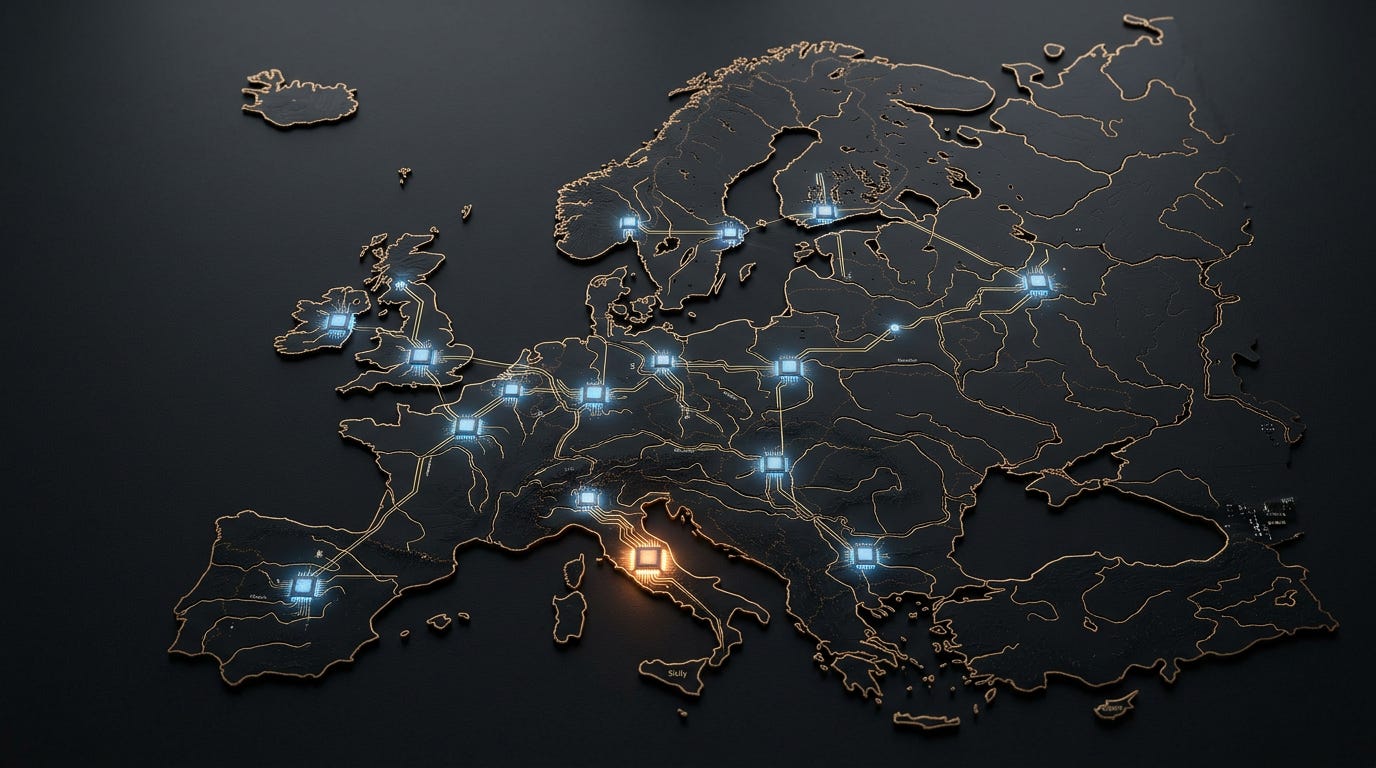
The challenge awarded EUROPA up to 2.5% of EuroHPC’s total computing capacity for one year, a figure that one secondary source described as the largest single compute allocation ever offered to a European AI project. EuroHPC’s 12 supercomputers, which span the continent and include Alice Recoque, Europe’s first exascale system, constitute a network whose 2.5% represents compute capacity that no European private company has independently replicated. By routing supercomputing access through a competitive grant, the EU converts a resource previously available only to the most heavily capitalized private firms into a contestable public prize.
The Frontier AI Grand Challenge funded exactly one project, with the full compute prize awarded to a single winner. The single-winner design reflects a theory that frontier AI capability requires resource concentration sufficient to cross a threshold that distributed funding cannot reach. This concentration makes the entire European frontier AI strategy dependent on one consortium’s execution, with no structural fallback if EUROPA fails to deliver.
Domyn, founded in Milan in 2016 as iGenius and rebranded in June 2025, built its core business supplying AI architecture to regulated industries including finance, government, and defense. The company pioneered large-scale FP8 pretraining, launched Italia as an open-source foundational LLM for the financial services industry, and collaborated with NVIDIA on Italy’s sovereign AI infrastructure. Domyn crossed the unicorn threshold in 2024, drawing investment from G42, Eurizon Investimenti, and NovaCapital, a trajectory that positions the EUROPA consortium’s lead company as a credentialed commercial actor with a track record extending beyond academic research infrastructure.
Multilingual obligations
The challenge specification required proposals to target models of at least 400 billion parameters built on a Mixture-of-Experts architecture, setting the technical floor that Domyn must clear. In a Mixture-of-Experts model, parameters are organized into specialized subnetworks that activate selectively per input, so a 400-billion-parameter system routes each prompt through only a fraction of its total capacity and carries substantially lower inference costs than a dense transformer of equivalent size. At 400 billion parameters, EUROPA targets a scale that places it in the same order of magnitude as the leading frontier systems from the United States and China.
Frontier-scale training has consistently produced models that perform most strongly in high-resource languages, particularly English, because English-language data constitutes a disproportionate share of the publicly available text corpora on which pretraining draws. Several official EU languages serve small speech communities with limited digital corpora, a scarcity that adding parameters cannot resolve because the underlying training signal simply does not exist at the scale that frontier pretraining requires. Safety evaluation presents an additional asymmetry: the benchmark datasets and red-teaming infrastructure that validate model behavior are far less developed for low-resource EU languages than for English, so a model that scores well on aggregate metrics may carry unexamined failure modes in its weakest languages.
Language equality in the EU carries legal force anchored in treaty obligations, citizenship rights, and the right of access to democratic institutions, giving EUROPA’s language coverage a political dimension that technical performance metrics cannot reduce to a single score. The AI Act’s compliance framework applies to every language in which a model operates, so a model that performs adequately in German or French but fails in a lower-resource official language generates regulatory exposure in the member states where that language holds official status. Together, the challenge specification’s 24-language requirement and the EU’s regulatory framework bind Domyn to deliver coverage of every official language, with technical shortfall in any of them constituting failure on both engineering and legal grounds.
Compliance from the ground up
Accepting public supercomputing allocation brings obligations around transparency, energy accountability, data governance, and safety that privately funded frontier AI development does not carry in the same form. The challenge’s eligibility rules required participants to commit to AI Act compliance, Horizon Europe open science principles, and broad community access to resulting models, encoding accountability as a structural precondition embedded in the selection criteria. Mistral, financed through private capital, faces none of the accountability conditions that attach to Domyn’s public compute allocation, because private financing carries no equivalent obligation to open science, data governance standards, or safety reporting.
EUROPA will be built under an AI Act that has yet to become fully operational, with the EU having reached a political agreement only in May 2026 on an omnibus package to simplify the rules, a process that the Commission had proposed in November 2025 and that is still working through implementation. If Domyn trains a 400-billion-parameter model to AI Act compliance from the outset, without retrofitting existing architecture to regulatory requirements after the fact, the result will offer the first evidence that frontier performance and compliant development can coexist within a single architecture, an outcome that EU Executive Vice-President Henna Virkkunen described as EUROPA’s explicit purpose. If Domyn cannot simultaneously achieve frontier performance across all 24 official EU languages and satisfy the Act’s safety requirements, the shortfall will undermine the AI Act’s core premise that competitive capability and robust safety compliance can share the same architecture.