
Silicon Cellar Hands
Homebrewers want AI to read the data, not write the recipe.

The science of homebrewing is well documented and the recipes circulate freely, yet the distance between a recipe file and a glass of good beer remains substantial. Mash temperatures, yeast health, water chemistry, and sanitation all interact in ways that reveal themselves only across multiple batches, and the homebrewing community treats that accumulated experience as the hobby’s central reward. The hobby’s online forums run on detailed batch notes, troubleshooting threads, and process debates that reflect a culture of earned expertise. AI has arrived in the garage brewery, offering sensors that watch fermentation around the clock and chatbots that generate complete recipes on demand, and homebrewers have been selective about which tools they welcome.
Clankers watching the sensors
For most of homebrewing’s history, fermentation monitoring meant watching an airlock for bubbles and marking days on a calendar. Experienced brewers learned to read the signs, but the process demanded frequent physical checks on a vessel that preferred to be left alone. Infrequent monitoring meant invisible problems. A temperature swing overnight could push yeast into producing harsh fusel alcohols, and a stalled fermentation left unnoticed for days could leave residual sugar that ruined the finished beer.
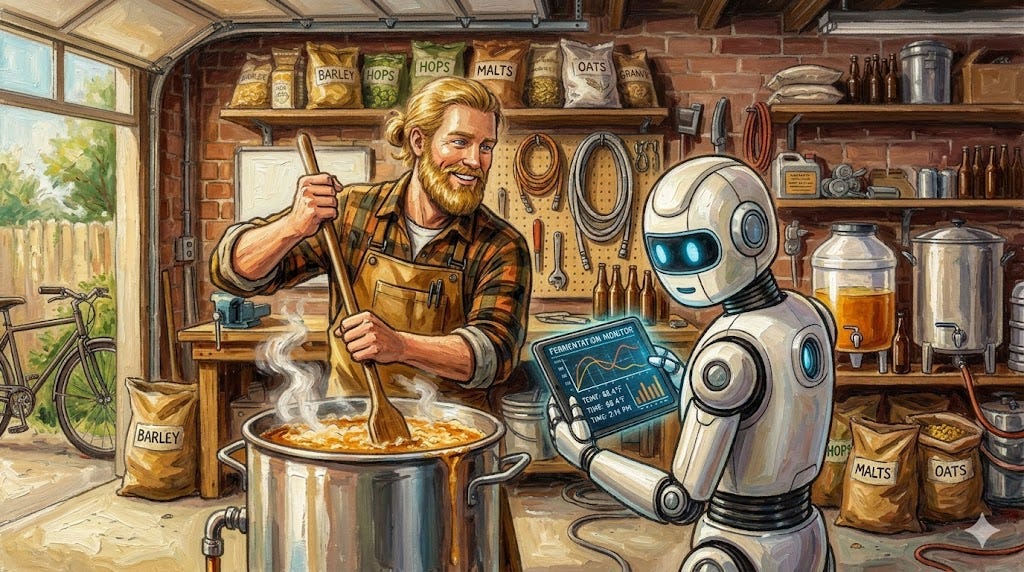
A generation of Wi-Fi-connected sensors has changed that picture. The Plaato Airlock V3 sits where a traditional airlock would and counts CO2 bubbles through an infrared sensor, back-calculating specific gravity and alcohol percentage from the volume of gas produced. The app plots bubbles per minute, estimated gravity, and ambient temperature on a single dashboard, giving the brewer a continuous view of yeast activity without opening the fermenter. MyBrewbot monitors temperature and gravity remotely and sends alerts when parameters drift. The iGulu F1 pushes further into automation, managing fermentation pressure and temperature from a countertop unit after the brewer scans an RFID recipe card and walks away.
These tools handle measurement and environmental control without touching creative decisions. Brew management platforms like Brewfather and BeerSmith were already standard for recipe formulation and batch logging, and the new sensors plug into that existing workflow. A reviewer on Homebrew Finds found that the Plaato’s gravity data helped time dry-hop additions and cold-crash scheduling, but concluded that the device did not make the beer any better. The sensor added information, and the brewer still made every choice about what to do with it.
The human touch
AI recipe generators have arrived alongside the hardware. Homebrewing.ai, a custom GPT, produces Brewfather-compatible BeerXML files from a text prompt, allowing a brewer to describe a desired style and receive a formatted recipe with grain bill, hop schedule, mash profile, and yeast recommendation. Craft Beer Wizard, built on Claude, validates its output against 73 recognized style parameters for IBU range, original gravity, and ingredient appropriateness. A general-purpose chatbot can produce a credible hazy pale ale recipe in seconds, and the surface quality is high enough that a brewer unfamiliar with the style might not spot the problems immediately.
Homebrewing forums have found those problems quickly. One brewer tested a ChatGPT hazy pale ale by importing it into Brewfather and discovered that 60 grams of Mosaic at a 60-minute boil calculated to 156 IBU, roughly five times the style’s upper bound. The model had produced a plausible ingredient list with implausible quantities. Another noticed that a generated recipe included a secondary fermentation step, a practice that the homebrewing community largely abandoned years ago after concluding that it introduced more oxidation risk than clarity benefit. Contributors on Homebrew Talk observed that AI recipes consistently ignore water chemistry, equipment calibration, and yeast pitch rates. These variables determine whether a correct recipe produces drinkable beer on a specific system.
The community’s resistance runs deeper than accuracy. Recipe development involves understanding how dozens of variables interact, and that understanding accumulates across batches, through failures as much as successes. A brewer who lets AI skip that learning process gets a recipe but lacks the diagnostic knowledge to adjust the result when it tastes wrong. The stuck fermentation, the too-bitter batch, and the eventual beer that tastes exactly right are all part of learning the craft, and a recipe generator cannot replicate that sequence.
Assistance beats replacement
Sensors that make fermentation legible have found a natural audience because they leave every decision with the brewer. Recipe generators may improve as the underlying models learn to account for equipment differences and local water profiles, but the community’s resistance reflects something beyond current accuracy limits. Homebrewers chose a hobby defined by hands-on learning, and a tool that proposes to skip the learning has misjudged what it was offering to automate.