
Shaken, Not Hallucinated
AI-powered cocktail apps are solving real problems for home bars, and stumbling up against familiar limits to their utility.

The bottles on a typical home bar arrive from different directions: a gifted Aperol, a mezcal purchased for a recipe that required half an ounce, a maraschino liqueur open since a party nobody quite remembers. Together they represent dozens of possible combinations, almost none of which their owner has tried. The usual evening ends with the same gin and tonic or whiskey sour, because the gap between a random assortment of spirits and a cocktail worth making is territory that most people cannot navigate without a recipe book and a second trip to the store. A growing category of AI-powered apps has converged on this specific gap, and the ones that work best stay closest to the physical shelf.
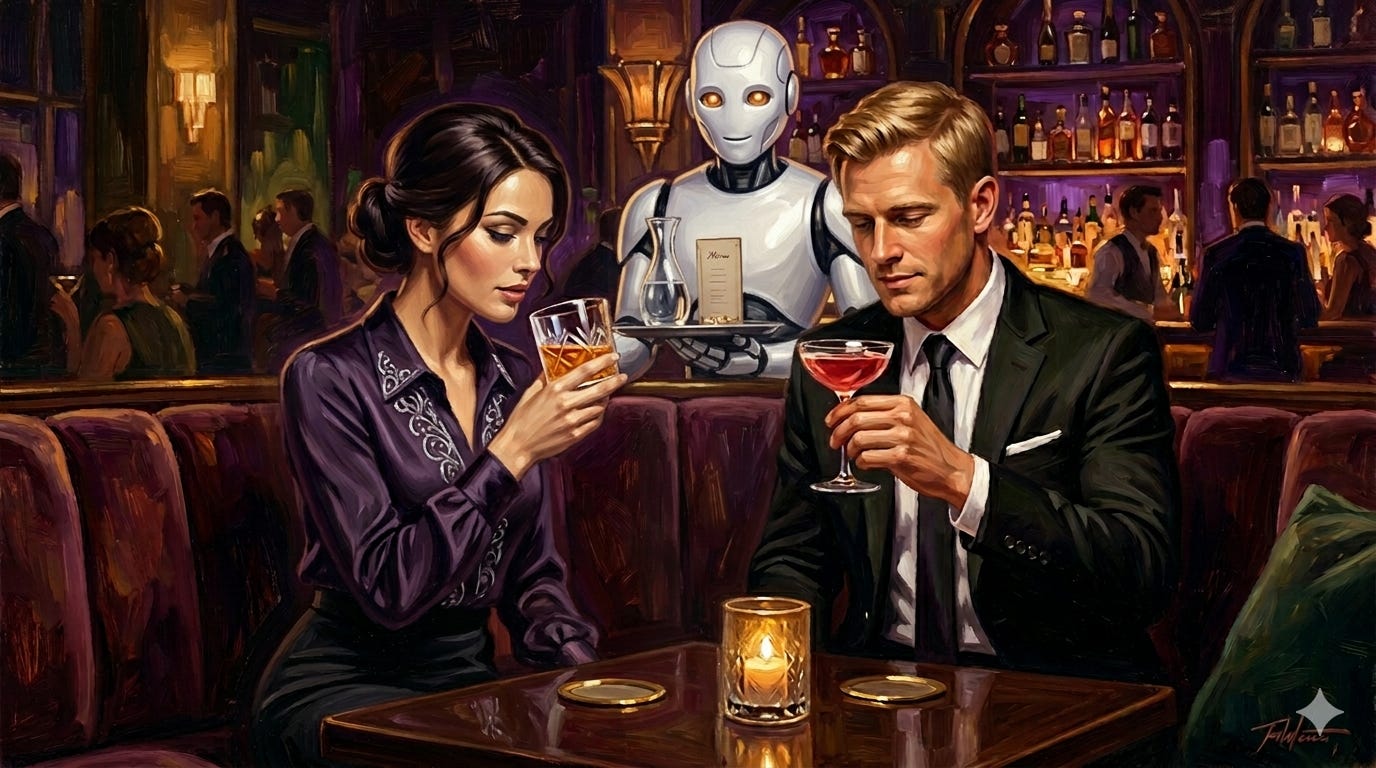
A constrained optimization problem disguised as a liquor cabinet
Cocktail recipes have never been scarce. The internet hosts millions, organized by spirit, by occasion, by ingredient count. A home bartender’s actual constraint is more specific: a bar with particular bottles, a desire for something beyond the usual rotation, and no efficient way to bridge the two. A shelf stocked with eight spirits, four mixers, and a handful of fresh ingredients can theoretically produce hundreds of distinct drinks, but identifying which combinations actually taste good requires knowledge that most people lack and time that nobody has. That bridging problem, matching a finite inventory to drinkable output, is a constrained optimization task, and constrained optimization happens to be something AI handles well.
A wave of apps has converged on this task. Mixel, which maintains a library of over 2,600 recipes, lets users log every bottle they own and filters its catalog to show only drinks that the available inventory can produce. My AI Bartender takes the inventory step further with computer vision: point a phone camera at the shelf, and the app identifies each bottle at roughly 90 percent accuracy, building the catalog automatically. BarGPT and Bartender AI add mood and occasion as inputs, generating suggestions tuned to a Friday-evening feeling as well as a liquor cabinet. The shared architecture across all of them starts from what’s physically available and navigates within it.
The one-shot upgrade
The cleverest feature in this category may also be the simplest. Mixel’s “Maximizer” calculates which single bottle purchase would unlock the most new recipes from a user’s existing inventory. A home bar stocked with gin, bourbon, and a few standard mixers might discover that adding Cointreau opens fourteen new drinks while Chartreuse opens three. Deciding what to buy next, a question that has always meant browsing recommendations or trusting a liquor-store employee, becomes a problem with a quantifiable answer.
A more analytical layer sits beneath the consumer apps. Databases built on molecular gastronomy research score ingredient pairings by shared volatile compounds, identifying which spirits and mixers complement each other at the molecular level. Commercial platforms add cost-per-ounce calculations and yield forecasting for bars managing a full cocktail program. Even these professional tools stay anchored to tangible constraints: available stock, cost ceilings, seasonal access to fresh ingredients.
As always, a step too far
The Breakreal R1, which debuted at CES in January, occupies the opposite end of the ambition scale. Billed as a “conversational AI bartender,” the countertop machine uses a large language model to generate cocktail recipes from mood prompts and dispenses them automatically, at a price between $1,099 and $1,299. During a CES demonstration, a company representative entered a prompt about being happy to be at the show, and the R1 produced a drink in about a minute. Vice, which covered the demo, reported that the reviewer could not identify what the machine had made, noting only that “it did make... something.” The machine holds a maximum of eight ingredients at a time, which limits the very combinatorial space that justified using AI in the first place.
The R1 illustrates a pattern visible across the cocktail-AI landscape. AI processes correlation efficiently: rosewater and cardamom co-occur in Persian desserts, so a model predicts that they will pair well in a glass. The prediction often holds, but no model can register that too much rosewater turns soapy, or that a particular person finds cardamom overwhelming after the second sip. Those thresholds live in a palate, and no training dataset encodes one. The apps that accept this boundary, managing the logistics of the cabinet while leaving the tasting to the drinker, generate the repeat usage.
Leave the fun to the user
The home bar offers a tidy illustration of where AI finds its boundary in everyday life. Everything up to the glass is computable: inventory, combinatorics, purchasing optimization, the probability that two compounds will complement each other. Everything past the rim requires the person holding it, because balance, preference, and the response of a particular palate to a particular pour resist encoding. An app can tell you that Cointreau, lime juice, and tequila produce a Margarita. Deciding whether to shake it a few seconds longer, whether the lime needs another quarter-ounce, and whether the result actually tastes right are calls that stay with the person holding the glass.