
Running With the Robots
AI is becoming every recreational runner’s personal trainer, and the results speak for themselves.

The generic training plan was a familiar object: a schedule of runs built around weekly mileage targets and a long run that lengthened incrementally toward race day. Runners followed these plans on the understanding that the periodization logic embedded in the structure represented the accumulated knowledge of coaches and exercise scientists, and that following it faithfully was the closest a recreational runner could get to proper coaching.
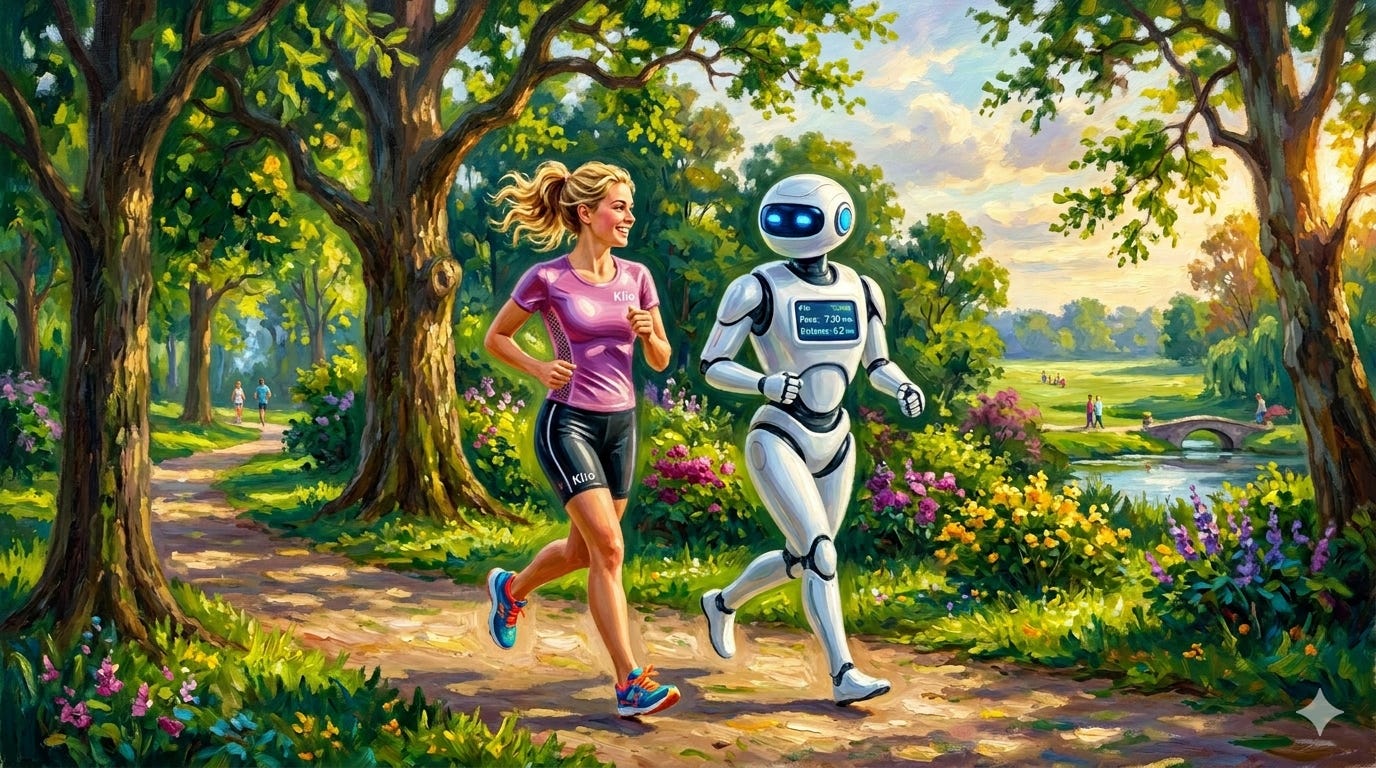
That relationship between runner and plan has changed considerably in the past few years. Platforms like Runna, TrainAsONE, and Athletica now offer individually tailored training plans for the price of a monthly subscription, updating after every run as new data arrives. The in-run coaching presence that once required a human alongside the athlete on a bicycle now arrives through an earpiece or a wrist tap, delivering pace cues, effort feedback, and real-time adjustments based on heart rate.
Trickle-down aerobics
Until recently, a personal running coach cost several thousand dollars a year, a price that confined individualized training guidance to competitive runners and a narrow tier of dedicated amateurs willing to treat the sport as a serious financial commitment. Everyone else trained on a plan, typically a PDF downloaded from a running website or borrowed from a book, structured around weekly mileage targets and a long run that grew incrementally toward race day.
Those plans shared a common origin: periodization research conducted mostly on competitive runners, adapted downward for recreational paces through the accumulated intuition of coaches and exercise scientists. They were reasonably good at building general aerobic fitness, but had limited capacity to account for how a specific runner recovered between sessions, what injuries she carried into the training block, or how her schedule actually behaved week to week.
Gameplan and playcall
A human running coach traditionally provided two things: a training plan tailored to the athlete’s fitness and race goals, and a presence during workouts to read fatigue and adjust effort in real time. AI has disaggregated these into distinct products. Platforms like Runna, TrainAsONE, and Athletica handle the plan layer, building and continuously updating training architecture specific to each runner. The in-run voice comes separately, through Samsung’s Galaxy Watch with its Gemini-powered Running Coach, or apps like Kasi and NXT Run, which deliver pace cues and effort feedback through earbuds or a wrist alert during the workout itself.
The scale of the shift became visible when Strava acquired Runna in April 2025, an AI coaching app that had reached users in 180 countries and been named a finalist for Apple’s App of the Year the previous year. Strava had 150 million registered users, and running was the platform’s fastest-growing sport. The acquisition signaled that AI-driven training plans had moved from a niche product to a feature the world’s largest fitness community considered essential.
A voice cue from a Galaxy Watch or an app like Kasi synthesizes pace, heart rate, and effort into a judgment about whether to ease off because the current effort already exceeds the target zone or to hold because there is physiological room to push. A human coach on a bicycle once offered elite athletes this kind of real-time attention during the workout itself, reading fatigue and knowing when a runner had more to give. An earpiece and a subscription now fill that role.
Almost too perfect
The first encounter with an AI-generated plan can produce a specific kind of unease. The plan caps the long run shorter than expected, schedules the taper weeks earlier than seems warranted, and places rest days where the runner anticipated hard sessions.
TrainAsONE describes its method explicitly: the system evaluates thousands of potential training combinations against the runner’s own data and selects the path its model judges most efficient for that specific athlete. The company argues that traditional plans derive from common coaching practice, and that the algorithm carries no obligation to replicate them. A November 2025 study in Scientific Reports, which tracked 120 recreational marathon runners through a 16-week personalized training trial, found that matching methodology to individual physiology produced roughly 30 percent better performance gains than either standard approach alone. The same study noted that between 10 and 30 percent of runners achieve little from generic protocols regardless of effort, a finding the researchers traced to individual physiological variation.
The AI plan’s strangeness is a function of its specificity. Conventional frameworks encoded what worked across populations and presented that as guidance. They served most recreational runners well enough to remain credible while leaving individual variation largely unaddressed. A plan optimized for one person will rarely resemble a plan optimized for the average.
The new standard
Somewhere between 30 and 75 percent of recreational runners get injured in any given year, a range wide enough to suggest that individual variation is the dominant factor. Generic plans had no mechanism to track how much load a specific runner could absorb before tissue broke down, which meant they could build fitness on average while quietly exceeding the tolerance of any individual who recovered more slowly than the model assumed.
The performance data points in the same direction. The Scientific Reports study found roughly 30 percent better gains from personalized methodology than from either standard approach, and the researchers attributed the improvement to individual calibration rather than to greater training volume or intensity. Running is one instance of a broader pattern: AI has made individually tailored expert guidance available at a subscription price, collapsing the financial barrier that once separated the recreational runner from the competitive one.
I used AI last year to go on a long fast to fix a health issue I had. It had to be a long fast, the AI told me. And it guided me through an extreme fast and I ran into all kinds of problems but each problem the AI showed me exactly how to fix it. It worked every time. And in the end, my issue was fixed and I feel better than ever. And have a way better understanding of how the human body works.
The specific feedback it can give you is truly incredible. A human being can never be there for you in such a specific and nuanced way, answering a million questions along the way.
This year I want to use it for fitness, similarly to how I used it last year.
Maybe for fitness they can do some kind of augmented reality. Like if you wanted Iron Man to be your training coach or something and can produce some kind of VR/augmented reality hologram as it guides you through workouts and helps you tailor your diet and your workout. I used it to learn cooking skills too.
The biofeedback, I think, is absolutely ripe with AI potential. Glad to see it getting implemented here.