
Right Tools, Wrong Debate
Game designers know exactly which parts of the job they want AI to handle, and art isn’t one of them.

If you want to understand how creative communities actually deal with AI, skip the tech industry’s press releases and look at board games. The tabletop design world has spent the first half of 2026 in a rolling argument about generative AI, complete with a high-profile firing, publisher boycotts, and a professional survey that produced sharper data than most industries have managed. The fight has been loud and passionate, and it has focused almost entirely on the wrong thing.
Utility first
The Tabletop Game Designers Association surveyed 171 designers in early 2026 and found that over half had used generative AI for some element of their work. TTGDA asked about seven use cases spanning ideation, placeholder text, final copy, editing, placeholder art, final art, and marketing. The accepted uses clustered around utility, from editing and proofreading to writing spreadsheet formulas for probability calculations. One of the most common additional applications was help with balance and math, though nearly as many designers reported that AI produced unreliable results, with one calling it “surprisingly bad” at detailed calculations. Several respondents noted that the AI’s creative output was derivative, but that the process of talking through a design problem helped them clarify their own thinking.
The rejected uses told a sharper story. Roughly four in five designers strongly opposed AI-generated art in finished products, and only two of the 171 respondents reported using AI art they planned to keep in a final game. Twenty-eight percent of respondents were strongly opposed to all seven use cases, while nearly a fifth had no strong opposition to any of them. The line that divides the community runs between AI as a thinking partner and AI as a creative substitute.
Fanatical red lines
In February, AEG’s COO Ryan Dancey posted on LinkedIn that he had “zero reason to believe” AI couldn’t generate ideas as good as Tiny Towns or Cubitos, two of his own company’s titles. Dancey had spent thirty years in the industry, had helped negotiate the sale of TSR to Wizards of the Coast, and had architected the Open Gaming License that opened D&D to third-party publishers. He lost his job the next day. AEG CEO John Zinser posted on Bluesky that the departure reflected the need for “leadership alignment,” and Dancey later clarified that he had meant ideas, not finished designs. This distinction didn’t register with a community that had already drawn its line.
The broader AI art wars reinforce this focus. Games Workshop banned AI in its designs while posting record revenue. Stonemaier Games, the publisher of Wingspan and Scythe, declared that the company wanted “nothing to do with it.” Asmodee’s CEO confirmed that the company would not use AI art in its own productions. The Terraforming Mars expansion had sparked one of the earliest backlashes after using AI-generated art in a Kickstarter campaign, though the project still raised over $2.2 million from more than 19,000 backers. The energy has been enormous, and it has landed on the applications of AI least connected to the actual bottleneck in game design, which has always been testing and iteration.
Room for novelty
One TTGDA respondent described a different kind of AI tool altogether, one that would run repeated models of a game to catch edge cases and broken strategies. This kind of tool, they wrote, would never replace human playtesting “for psychology and actual fun” but might save designers some repetitions.
That tool already exists in early form. GameGrammar, launched in February by Dynamind Research, generates structured board game drafts from text prompts and includes a balance critic that flags high-severity issues before a prototype reaches the table. In video games, ManaMind raised $1.5 million in April to build autonomous agents that complete full regression cycles in six hours, catching 86% of critical bugs before shipping. Razer showcased AI gameplay agents at GDC 2026 that execute test scenarios and generate bug reports without human supervision. For indie developers without QA budgets, these agents play the game every wrong way they can find, systematically exercising paths and edge cases that designers miss because they play their own games the “right” way.
The GDC’s 2026 State of the Game Industry Report found that 52% of professionals across the broader game industry believe generative AI has a negative impact on their field, nearly triple the figure from two years earlier. The investment pattern tells a more granular story, with funded tools focused on testing and simulation while the public debate centers on art and authorship.
Prototypes and playtesters
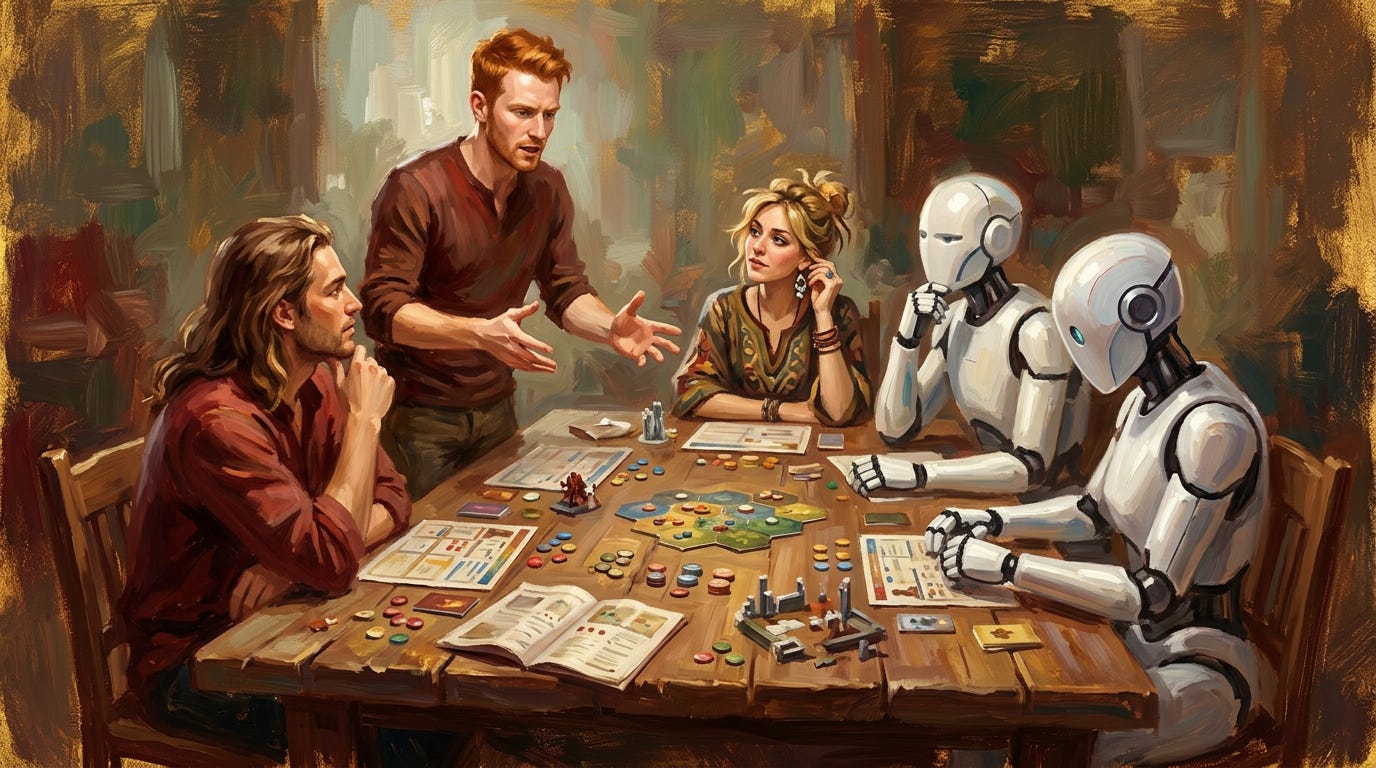
Game designers may have articulated this divide more clearly than anyone else because their medium demands physical proximity to the player. A board game prototype goes onto a table, and someone sits across from another person and watches their face when a mechanic clicks or fails. That feedback loop is the part of the process no designer wants to surrender. Running the same game fifty times to catch a broken strategy is a different matter entirely, and AI absorbs that kind of repetition well. The rest of the design world, from software engineering to industrial design, faces a version of the same question. The board game community, with its physical prototypes and face-to-face playtests, may have answered it first.