
Raging Against the Machine Gods
Over 1,000 authors are begging publishers not to use AI

This may be the most desperate Hail Mary ever thrown by anyone. A group of more than one thousand authors is begging the Big Five publishing houses in the US to foreswear selling AI-generated books.
A group of more than 70 authors including Dennis Lehane, Gregory Maguire and Lauren Groff released an open letter on Friday about the use of AI on the literary website Lit Hub. It asked publishing houses to promise "they will never release books that were created by machines."
Addressed to the "big five" U.S. publishers — Penguin, Random House, HarperCollins, Simon & Schuster, Hachette Book Group, and Macmillan — as well as "other publishers of America," the letter elicited more than 1,100 signatures on its accompanying petition in less than 24 hours. Among the well-known signatories after the letter's release are Jodi Picoult, Olivie Blake and Paul Tremblay.
The letter contains a list of direct requests to publishers concerning a wide array of ways in which AI may already — or could soon be — used in publishing. It asks them to refrain from publishing books written using AI tools built on copyrighted content without authors' consent or compensation, to refrain from replacing publishing house employees wholly or partially with AI tools, and to only hire human audiobook narrators — among other requests.
"The writing that AI produces feels cheap because it is cheap. It feels simple because it is simple to produce. That is the whole point," the letter states. "AI is an enormously powerful tool, here to stay, with the capacity for real societal benefits—but the replacement of art and artists isn't one of them."
The idea that the major publishers, who are struggling to survive the onslaught of Kindle Unlimited ebooks and Virtua Voice audiobooks, are not going to embrace AI to the full is delusional to the point of justifying commitment to an insane asylum.
"There are major concerns that publishers might create generative AI titles of their own that could swallow the publishing landscape, or replace editorial workers with AI tools, or the like.”
There should be, because that’s exactly what they are going to do. That’s what Spotify is already doing with music. And that’s exactly what Castalia House is going to do; we’re already working on using AI to provide translations into other languages and you can already read the first 14 chapters of Monster Control Incorporated, a machine-augmented novel serialized weekly on Sigma Game.
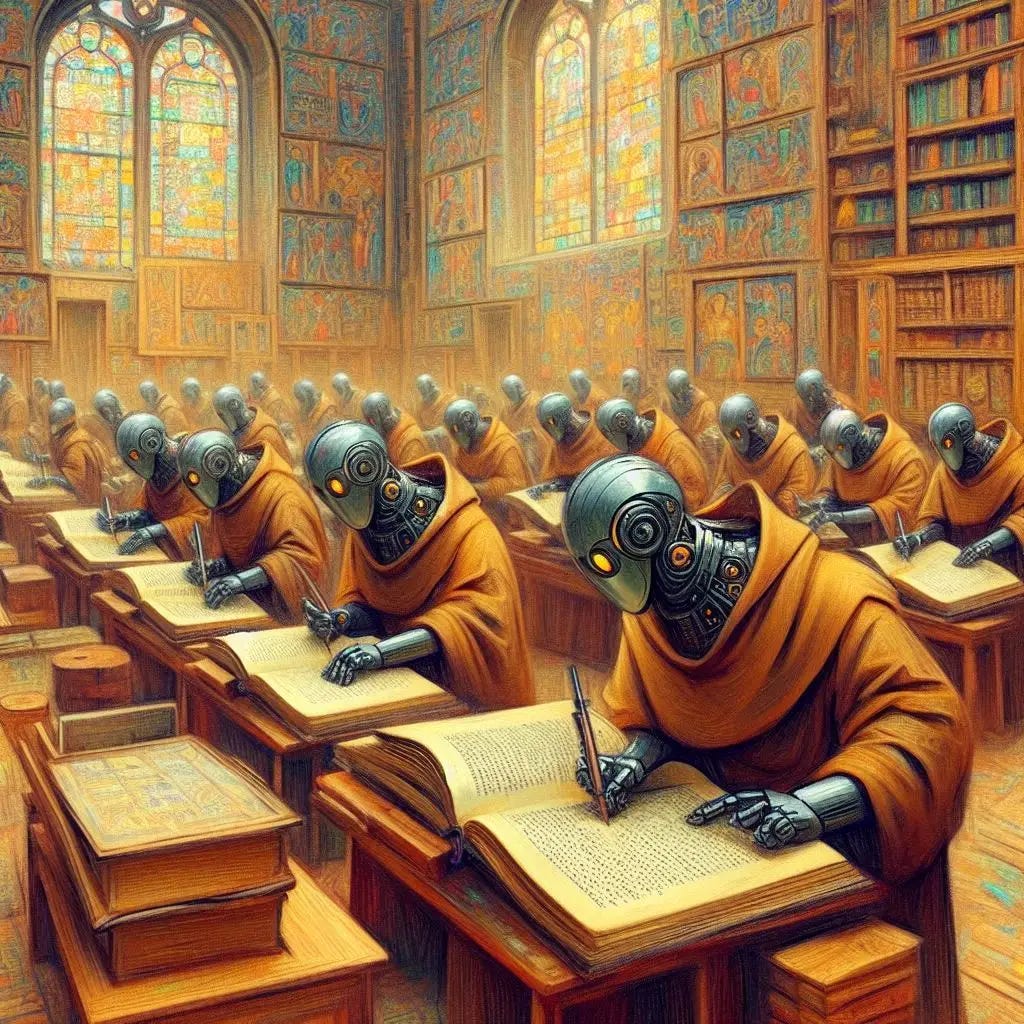
In fact, I will promise that Castalia House will not only release books that were created by machines, we intend to be the publishing house that creates and publishes the very best books created by machine-augmented humans. This is entirely in keeping with our original publishing vision as first laid out back in 2014.
Did we not promise a revolution in Science Fiction?
It was nearly 100 years ago when publishers started inventing fake authors like F.W. Dixon and Carolyn Keene and using ghostwriters to produce the books. I can absolutely guarantee that they will do exactly the same thing by utilizing AI, because the advantages and cost benefits of doing so are simply too great.
I get where people are coming from on this one, but they're looking at the whole thing entirely wrong.
It's not so different from the digital camera revolution; in the early days, film enthusiasts were convinced that digital could never match the quality. Then they started to panic. Today, everyone has multiple high-quality digital cameras to use whenever they desire. Even so, what effect has the proliferation of digital cameras and simple editing tools had on the numbers of professional photographers? It still takes skill, talent, and mastery to craft a good photo, and there are still a lot of people making a decent living doing wedding shoots and publicity shots for businesses. The smart ones are learning how to incorporate AI into their businesses now, too.
AI may generate books, but it still takes someone who has mastery over the craft of storytelling to turn that basic AI material into something truly worth reading.
Oddly, I appreciate both stands presented here.
And if the 'no-AI' authors band together and open their own business, they will achieve their goals relatively rapidly. Otherwise: Zero chance.
At this point, I would pay Castalia for a deep revision that rationalized Gravity's Rainbow or Finnegan's Wake for me. I have a sneaking suspicion they are crap (by my own personal barometer, not really relevant to anyone else) and I refuse to give them a 3rd, and 2nd chance, respectively, because time is too valuable.
Bonus points if (business idea incoming....) Castalia takes *audience prompts* and re-writes/condenses/explain/cartoonifies/etc such books and prints them. I don't mean "a summary" like Cliff/Spark Notes. I mean "hey Castalia, re-cast Moby Dick as a VC/founder tale, add in fintech, make it no longer than 150 pages and write with a hint of Colman McCarthy and Bret Easton Ellis. That's a service I'd pay for. And, I could still kinda/sorta talk about Moby Dick at my Hampton's cocktail party with the hedge fund bros. Wins all around.
Anyway: Good luck to all.
PS Monster's story is going well. Light fun. Looking forward to more.