
No More Side Quests
OpenAI has been forced into a massive strategic pivot.

In March, OpenAI consolidated its model line with GPT-5.4, announced the merger of ChatGPT, Codex, and its Atlas browser into a single desktop app, and shut down Sora. OpenAI is reorganizing around its main rival’s playbook, as Anthropic’s enterprise market share, its consumer download numbers, and its single-app product architecture have forced a reckoning.
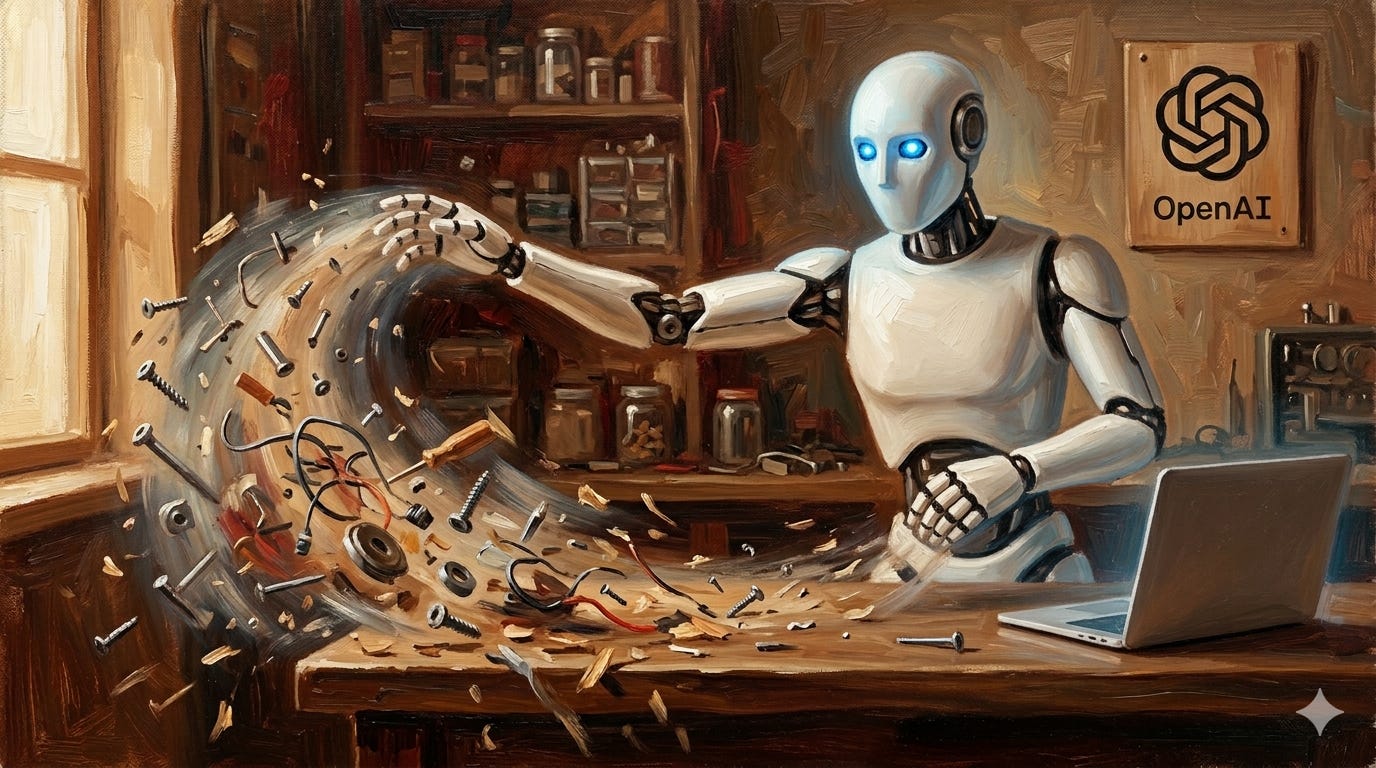
Code Red Consolidation
An Axios analysis of enterprise AI spending, cited inside OpenAI, found that Anthropic now captures 73% of all spending among companies purchasing AI tools for the first time. OpenAI has fallen to roughly 27%. On the consumer side, Claude overtook ChatGPT as the most-downloaded app in the United States this month. Anthropic holds both the enterprise pipeline and the consumer download charts.
Fidji Simo, the former Instacart CEO whom OpenAI hired last year to lead its applications business, held an all-hands meeting earlier this month. According to a partial transcript reviewed by CNBC, Simo told staff that the company is “orienting aggressively” toward high-productivity use cases and warned against being distracted by “side quests.” OpenAI will merge ChatGPT, the Codex coding platform, and the Atlas browser into a single desktop application aimed at coding and business productivity customers.
Anthropic already ships this architecture, with Claude’s chat interface, Claude Code, and Claude Cowork sharing one application. In an internal memo obtained by the Wall Street Journal, Simo acknowledged that spreading team energy across too many standalone apps had slowed momentum and hurt quality control.
The Everything Engine
OpenAI released GPT-5.4 on March 5 in Standard, Thinking, and Pro variants. This model absorbed the coding strengths of GPT-5.3 Codex, improved reasoning, and the company’s first native Computer Use API into a single release, ending a stretch in which each new frontier capability had shipped in its own purpose-built model.
OpenAI pitched GPT-5.4 as workplace infrastructure. This model scored 83% on the company’s GDPval benchmark for professional knowledge tasks and topped Mercor’s APEX-Agents benchmark in law and finance. Fortune framed the release as OpenAI’s bid for enterprise territory that had become Anthropic’s stronghold. GPT-5.4 also produced 33% fewer false claims per response than GPT-5.2, according to OpenAI’s testing.
Alongside the model, OpenAI shipped WebSocket mode for the Responses API. This feature maintains a persistent connection and sends only incremental inputs per turn, rather than resending full conversation history with each tool call. Workflows involving 20 or more tool calls run up to 40% faster, according to OpenAI. The company has built the plumbing necessary to sustain the multi-step agentic workflows they are targeting.
Hard Decisions
OpenAI killed Sora on March 24, shutting down the standalone app, the developer API, and ChatGPT’s video generation in a single announcement. The economics made the decision overdue. At peak, Sora consumed an estimated $15 million per day in inference costs. It generated $2.1 million in total lifetime revenue from in-app purchases, according to Appfigures, and monthly downloads had fallen from roughly 3.3 million in November to 1.1 million by February.
The Disney partnership died with it. Disney had pledged a $1 billion investment in OpenAI in December alongside a three-year license covering characters from Disney, Marvel, Pixar, and Star Wars. Three months later, the deal ended before any money changed hands. Disney said that it “respects OpenAI’s decision to exit the video generation business.” OpenAI dropped Instant Checkout from ChatGPT the same day, trimming another consumer-facing initiative.