
I Let AI Write Three Complete Novels While I Slept. Here’s What Happened.

The question isn’t whether AI can write a novel. The question is whether anyone will notice.
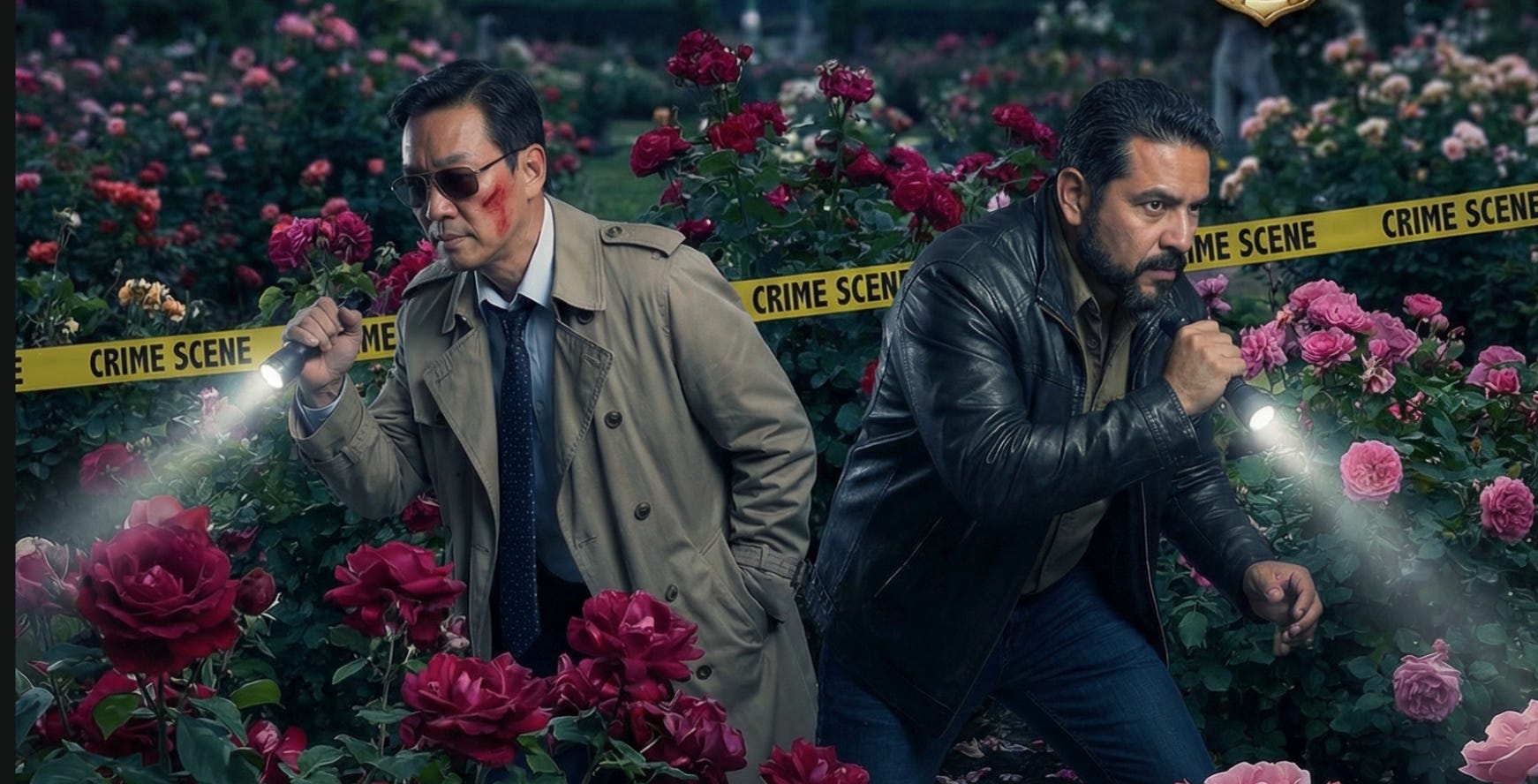
Last weekend, I ran a fully automated n8n workflow that generated three complete detective novels with a single human input: the genre. The result is Precinct 99, a buddy cop mystery series now available on Amazon. The first book, Bard of the Bay, is live. The Canvas Killer is on pre-order. The Garden of Graves follows after that.
I did this while sleeping.
Why This Experiment
Last week’s livestream we did got into AI-isms, the telltale prose patterns that signal machine-generated writing. The weight of something. The precision of something else. The “it’s not X, it’s Y” construction that appears constantly in AI output. These patterns are obvious once you know what to look for.
But they won’t last. AI writing is improving at a pace that makes current limitations look temporary. In two years, the prose quality will be dramatically better. The patterns will change. The tells will disappear.
So this was partly about capturing a moment in time—documenting what fully automated AI fiction looks like in early 2026, before the technology makes this version of the experiment impossible to replicate. And partly about answering a genuine question: will readers notice? Will they care?
Building the Machine
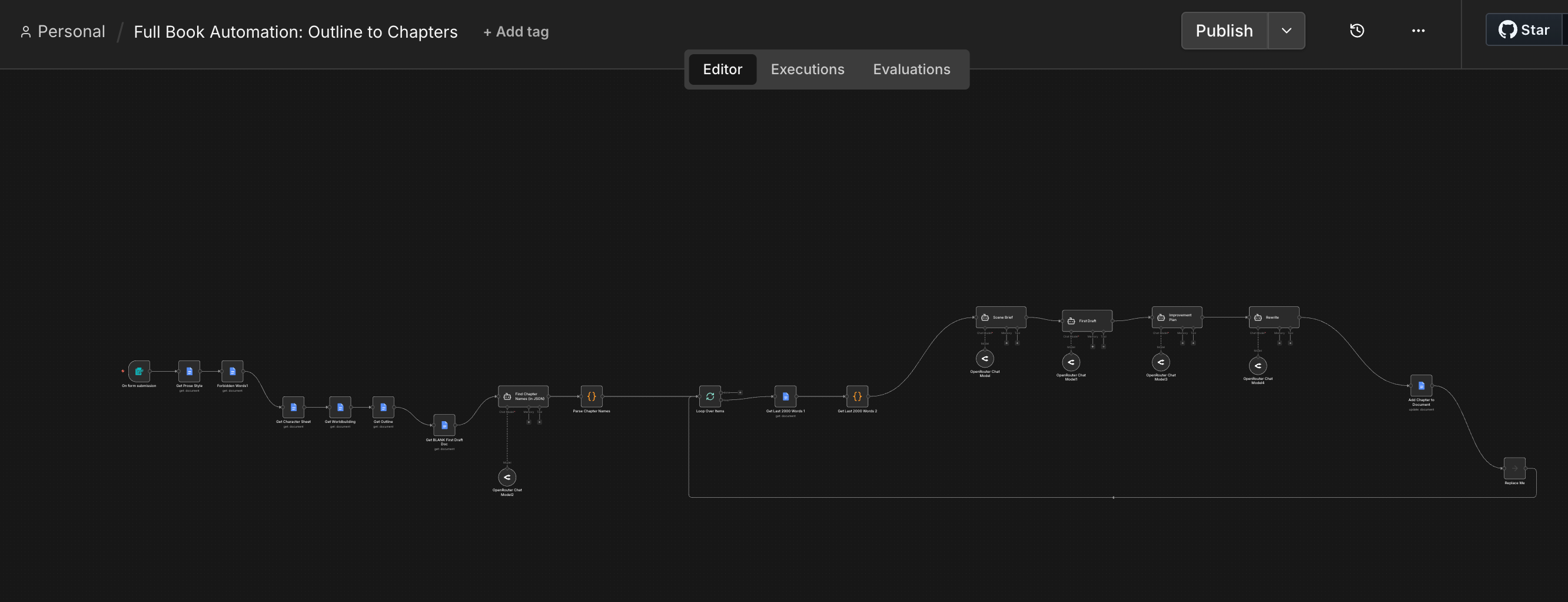
The workflow runs in n8n, an automation platform that allows complex multi-step processes to loop continuously without human intervention. The core problem with AI writing is context—most models can handle roughly 2,000-3,000 words before coherence degrades. Writing a full novel chapter by chapter normally requires constant human input: feeding summaries, maintaining continuity, redirecting when the narrative drifts.
The n8n workflow solves this by automating the entire chain.
Here’s how it works:
Step 1: Document Generation
Before the workflow runs, Grok generates all the foundational documents. I asked it to produce as many buddy cop mystery tropes as possible—then fed those directly into the system. Character sheets, world-building, prose style guidelines (specifically requesting maximum AI-typical prose patterns for this experiment), and a full outline were all generated by Grok with minimal direction.
For character names, I asked Grok what the most common AI-generated protagonist names were. The answer: Chen and Martinez. Those became the leads of Precinct 99.
Step 2: The Loop
Once the documents were loaded, the workflow runs on a circular loop:
Identifies the next chapter from the outline
Pulls the last 2,000 words of existing text for continuity
Generates a scene brief—a more detailed breakdown of the outline section
Drafts the chapter from that brief
Creates a self-critique and improvement plan
Rewrites based on that critique
Dumps the final text into a document
Loops back to the next chapter
The self-critique step is the most interesting part. The AI evaluates its own output, identifies weaknesses, and rewrites accordingly. It’s not perfect, but it produces noticeably better prose than a single-pass draft.
A forbidden words document was part of the setup—designed to filter out AI-isms. For this experiment, I left it blank intentionally. The goal was maximum AI slop, preserved for posterity.
I’ll note since I use an API with OpenRouter to source chatbots on this, the process isn’t free. Each book costs approximately $20 in credits using Claude Sonnett 4.6 to do the drafting work. There are cheaper chatbots, but Sonnett produces the most reliable results in my estimation.
The Problems

Nothing runs perfectly the first time.
The base automation came from a friend’s workflow, and his setup included perspective-handling prompts designed for a different kind of project. Those prompts confused the point-of-view structure of the early chapters, creating inconsistencies that required manual intervention. I had to go back through the first couple of books and have AI rewrite the affected sections.
After each book was generated, I ran the full manuscript through Claude directly with a single prompt: identify all continuity errors and plot holes. Claude returned a list of revisions. I then had it regenerate the affected chapters with those fixes applied. The plot coherence improved significantly with this pass.
Book two presented a different problem. When Claude analyzed both manuscripts together, it flagged that the second book’s outline was too similar to the first—Grok had been generating outlines from the same foundational documents and was producing repetitive story beats. The solution was to have Claude generate the outline for book three instead, creating a divergent plot line while maintaining series continuity.
For books two and three, I generated summaries of previous volumes and fed them into the workflow alongside updated character sheets and world-building documents. Continuity across a series requires the AI to know what happened before. This solved most of the cross-book consistency issues.
The Covers
Cover generation went through Nano Banana using Grok’s descriptions. I fed in character descriptions and setting details, and it produced workable cover art.
Book two caused a problem. I specified the museum setting—where the story takes place—and the generator produced the same two characters in the same pose as book one, just relocated to a museum interior. A second generation with explicit instructions to change the poses fixed it. Book three was set in a botanical garden with different character positioning specified upfront, which produced a more distinctive result.

The audiobook uses Amazon’s new AI narrator feature. The entire product is machine-generated. The only human decision in the entire pipeline was “buddy cop mystery with humor.”
The Books
Bard of the Bay opens the Precinct 99 series. Detectives Chen and Martinez investigate a murder in the Metro City theater scene. The setup hits every buddy cop beat: mismatched partners, procedural investigation, humor cutting through tension, a mystery that escalates beyond its initial scope. The AI-isms are present throughout—the prose has that particular quality of competent but slightly mechanical writing that characterizes current LLM output. Repeated phrases. Slightly formal sentence construction. The occasional “not X but Y” construction.
The Canvas Killer moves the investigation into the art world. The Garden of Graves takes the series outdoors to a botanical garden setting. All three books are complete and ready. They’re being released three weeks apart on Amazon as daily releases would signal the automation too obviously to potential readers.
What This Actually Proves
The prose is what it is. It repeats. It has patterns. A trained reader will spot them.
But here’s the thing: a lot of published human fiction repeats phrases and patterns too. The reason AI produces these patterns is that it learned from human writing, and human writing contains them. The question isn’t whether the prose is perfect—it’s whether it’s good enough to entertain a reader who picked up a mystery novel on Amazon.
That’s the experiment. The books are live. Reader reaction will determine whether the AI-isms matter to the audience they’re aimed at.
The technology will improve regardless. In two years, the patterns that make current AI prose identifiable will be gone. The workflows will be faster, the prose cleaner, the continuity tighter. What took a weekend of setup and a night of automated generation will take less time and produce better output.
This experiment captures the current state—the moment before that improvement makes it irrelevant. Precinct 99 is a time capsule as much as it is a book series.
Whether it’s also entertaining is something readers will have to decide for themselves.
Precinct 99: Bard of the Bay is available now on Amazon. The Canvas Killer and The Garden of Graves are available for pre-order.

What a brilliant experiment!
Cool experiment! I wish you hadn’t pushed it so hard on X that it was AI because a truly blind test would have been even more interesting. We know how a segment of the population hates everything AI.