
Hardware Reimagined
The first devices built for AI are arriving this year.

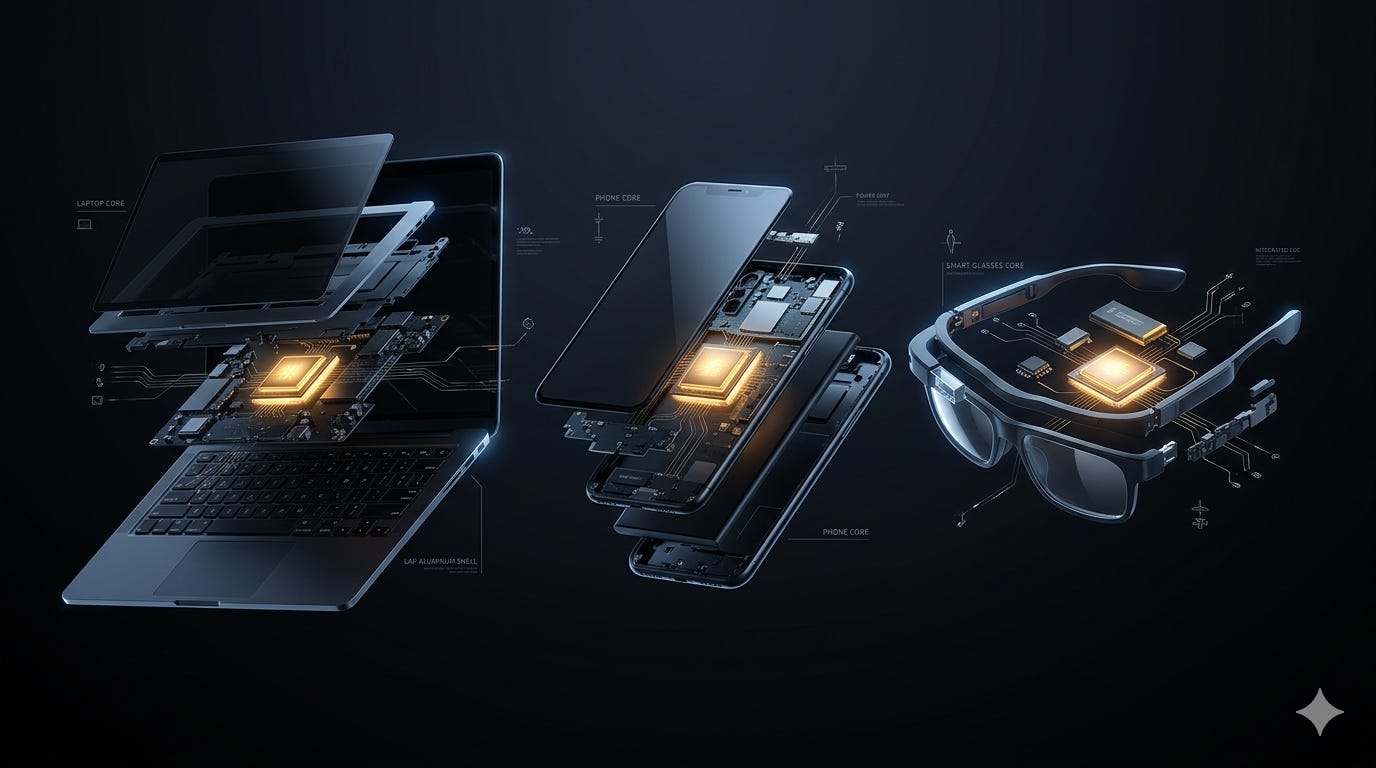
Google unveiled Googlebook, a Gemini-native laptop, last week. Samsung launched the Galaxy S26 in February as its “third-generation AI phone” and reportedly plans to debut Galaxy Glasses, running Android XR with Gemini, in July. These products span different form factors and different stages of the product cycle, linked by what each one prioritizes in its hardware.
The smart cursor experiment
Google announced Googlebook on May 12 as a new laptop category, the first the company has introduced since the Chromebook launched fifteen years ago. The platform merges Android and ChromeOS into a unified operating system with Gemini embedded at the system level. Alex Kuscher, Google’s Senior Director of Laptops and Tablets, described the goal as moving from an operating system to an intelligence system. Acer, Asus, Dell, HP, and Lenovo will ship the first devices this fall, with processors from Intel, Qualcomm, and MediaTek.
Magic Pointer, built with Google DeepMind, replaces the standard cursor with one that activates Gemini when the user wiggles it. Pointing at a date in an email offers to schedule a meeting. Selecting two images, a living room and a photograph of a couch, prompts a visualization of the combination. The cursor has remained essentially unchanged since the addition of the right-click, and Googlebook rebuilds it as the primary surface for AI interaction.
Google is enforcing strict hardware guidelines across all OEM partners, covering chips, memory, storage, and display quality. The chip vendors competing for Googlebook partnerships are differentiating themselves primarily on NPU performance, and the devices will sit at the premium end of the laptop market alongside MacBooks and Copilot+ PCs.
Mobile AI on the rise
Samsung’s Galaxy S26 series, launched in February, leads its spec sheet with a 39% NPU improvement, followed by a 19% CPU increase and a 24% GPU boost. Samsung describes the phone as its third-generation AI device, a label that makes on-device AI processing the generational marker for the flagship line.
That NPU headroom enables features running continuously in the background. Now Nudge reads screen context across apps and surfaces relevant actions without requiring the user to switch applications. When a friend mentions evening plans in a messaging thread, Nudge checks the calendar and flags conflicts. Call Screening answers unknown calls on the user’s behalf, transcribes the conversation, and presents a summary. Google’s on-device Gemini model powers a separate Scam Detection feature in the Samsung Phone app, identifying potential fraud during live calls. Samsung’s Personal Data Engine handles all of this processing locally, with Knox encryption isolating the data that makes these features work.
Samsung is extending this approach across its hardware lineup. Leaked plans describe Android-based Galaxy Book laptops running One UI 9, the same interface that runs on Galaxy phones and tablets, with Galaxy AI features and an improved version of DeX for cross-device continuity. Three tiers of laptop are reportedly in development. The phone’s AI layer is becoming the unifying platform for Samsung’s device ecosystem.
Cyberpunk extremes
Samsung’s Galaxy Glasses, reportedly set for unveiling at Galaxy Unpacked in London on July 22, run Android XR with Gemini as the built-in assistant. The hardware consists of a 12-megapixel camera, microphones, and speakers packaged in conventional eyewear frames, components that exist to give Gemini sensory access to the wearer’s surroundings. The glasses offload all processing to a paired phone, carrying no onboard compute. Samsung plans a display-equipped version for 2027.
Google is developing its own Android XR glasses in two tiers, a display-free pair for hands-free Gemini interaction and a pair with a built-in display that surfaces navigation and translation directly in the wearer’s line of sight. Partnerships with Warby Parker and Gentle Monster reflect the constraint that wearable AI hardware still has to look like something people will wear. Google I/O, running this week in Mountain View, is expected to provide additional hardware details.
The common architecture across all three form factors is Gemini, processing screen context on a laptop, personal data and app state on a phone, and the physical environment through a pair of glasses. Each device category shapes its hardware around a different input channel for the same underlying model.
The new headliners
For decades, hardware competition organized itself around processor clock speed, camera megapixels, display resolution, and battery life. Those specifications still appear in product announcements, but they have moved down the page. Samsung gives the S26’s NPU improvement top billing over its CPU and GPU gains. Googlebook chip partners compete on AI inference capability, and Samsung’s Galaxy Glasses carry a camera that exists to give Gemini a view of the physical world. The hardware reaching consumers over the rest of 2026 will lead with a different set of numbers on its spec sheet, ones that measure how well each device serves the AI model running on it.