
Full Stack or Bust
Qualcomm is committing $14 billion to build a full-stack alternative to NVIDIA’s AI infrastructure dominance.

Most people encounter Qualcomm’s products daily without knowing the company’s name. The San Diego chipmaker designs the Snapdragon processors inside most Android smartphones, a business that generated $10.6 billion in revenue last quarter. Its data center division, by comparison, brought in roughly $300 million across all of fiscal 2026. Last week, Qualcomm laid out plans to spend approximately $14 billion to change that.
A new line of business
At its Investor Day in New York on June 24, Qualcomm confirmed a $3.9 billion all-stock acquisition of Modular, the AI software company behind the Mojo programming language and the MAX inference engine. The deal includes co-founder and CEO Chris Lattner and roughly 150 employees. The confirmed acquisition arrived alongside reports that the company is in advanced talks to acquire Tenstorrent, the RISC-V AI chip company led by chip architect Jim Keller, at a valuation between $8 billion and $10 billion. Those two deals would cap a run that already includes RISC-V server chip designer Ventana Micro Systems, purchased in December 2025, and high-speed interconnect supplier Alphawave Semi, acquired for $2.4 billion. In under a year, Qualcomm has committed roughly $14 billion in acquisitions aimed entirely at AI data center infrastructure.
Bridging the software moat
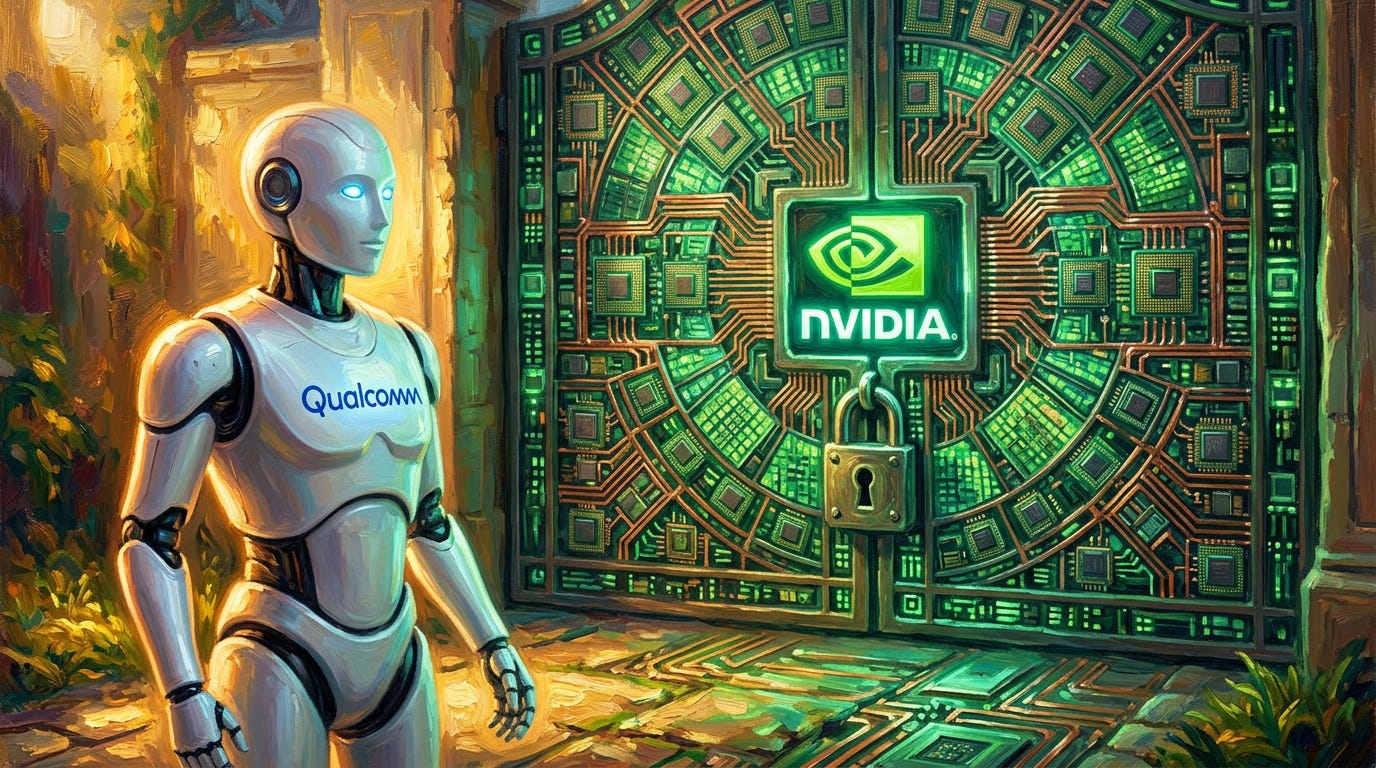
NVIDIA’s grip on AI computing rests less on its GPUs than on CUDA, the proprietary software ecosystem that has tied developers to NVIDIA hardware for over a decade. Writing AI code for CUDA means rewriting it to run on anything else. AMD’s ROCm, Google’s TPUs, and Amazon’s Trainium all offered competitive silicon but could not replicate the compiler toolchains, optimized libraries, and developer habits that make CUDA difficult to leave. AI researchers learn to write code on NVIDIA hardware from their first university course, and the accumulated weight of tutorials, documentation, and community support reinforces that dependency over entire careers.
Lattner founded Modular to address that specific problem. He created the LLVM compiler infrastructure that underpins most modern programming languages and later designed Apple’s Swift. Modular’s MAX inference engine runs AI models across chips from NVIDIA, AMD, Intel, and Arm without hardware-specific code rewrites, and the team built it without relying on any NVIDIA vendor libraries.
Tenstorrent would supply the accelerator layer. The company’s Blackhole chip, which reached general availability in April, packs 768 RISC-V cores per accelerator and approaches AI computation from a different architectural direction than GPU parallelism. RISC-V carries no licensing fees, which means that a completed acquisition would give Qualcomm accelerator silicon it owns outright, with no royalty flowing to a competitor. Keller designed the AMD K8, Apple’s early mobile processors, AMD’s Zen architecture, and Tesla’s self-driving chip. That track record accounts for much of the premium over Tenstorrent’s $3.2 billion valuation from a year earlier.
The RISC-V strategy also serves as insurance against Qualcomm’s fraught relationship with Arm. In 2021, the company acquired a startup called Nuvia for $1.4 billion, and Arm sued, arguing that the chip designs could not transfer without its permission. Qualcomm won decisively, but the dispute demonstrated that a licensor competing directly with its licensees retains leverage that courtroom victories alone do not fully remove.
The mission statement
Meta CEO Mark Zuckerberg appeared at the Investor Day to announce a multi-generational CPU partnership centered on the Dragonfly C1000, a 250-core server chip scheduled for 2028. Microsoft has also committed to Qualcomm’s AI chips. CEO Cristiano Amon told investors that the company had been “collecting assets” and now possessed a comprehensive portfolio for data center entry. Qualcomm doubled its non-handset revenue target to $40 billion by fiscal 2029, with data center revenue alone projected to reach $15 billion of that total. The stock rose 15% on the announcements.
The distance between those targets and current revenue remains enormous. Qualcomm attempted an Arm-based server push in 2018 and abandoned the effort entirely. That venture failed in part because the software ecosystem around Arm server chips never reached the maturity that enterprise customers required. Integrating Modular’s compiler stack with Tenstorrent’s RISC-V accelerators, Ventana’s server cores, and Qualcomm’s existing Arm-based CPU designs into a coherent product line presents a coordination challenge at least as formidable as any of the individual technologies involved.
A new approach
NVIDIA built CUDA’s dominance over fifteen years by cultivating an ecosystem of developers, libraries, and university curricula alongside the hardware, creating a moat deeper than any single product. No previous challenger addressed that moat directly. Qualcomm is the first to purchase the software layer alongside the silicon, an approach that acknowledges competitive chips alone have never been sufficient to displace NVIDIA. Buying the components and integrating them into a working alternative remain different accomplishments, and NVIDIA’s head start measures in years.