
Deconstructing the Anti-AI Art Discourse
The Labor Theory of Value as Aesthetic Epistemology
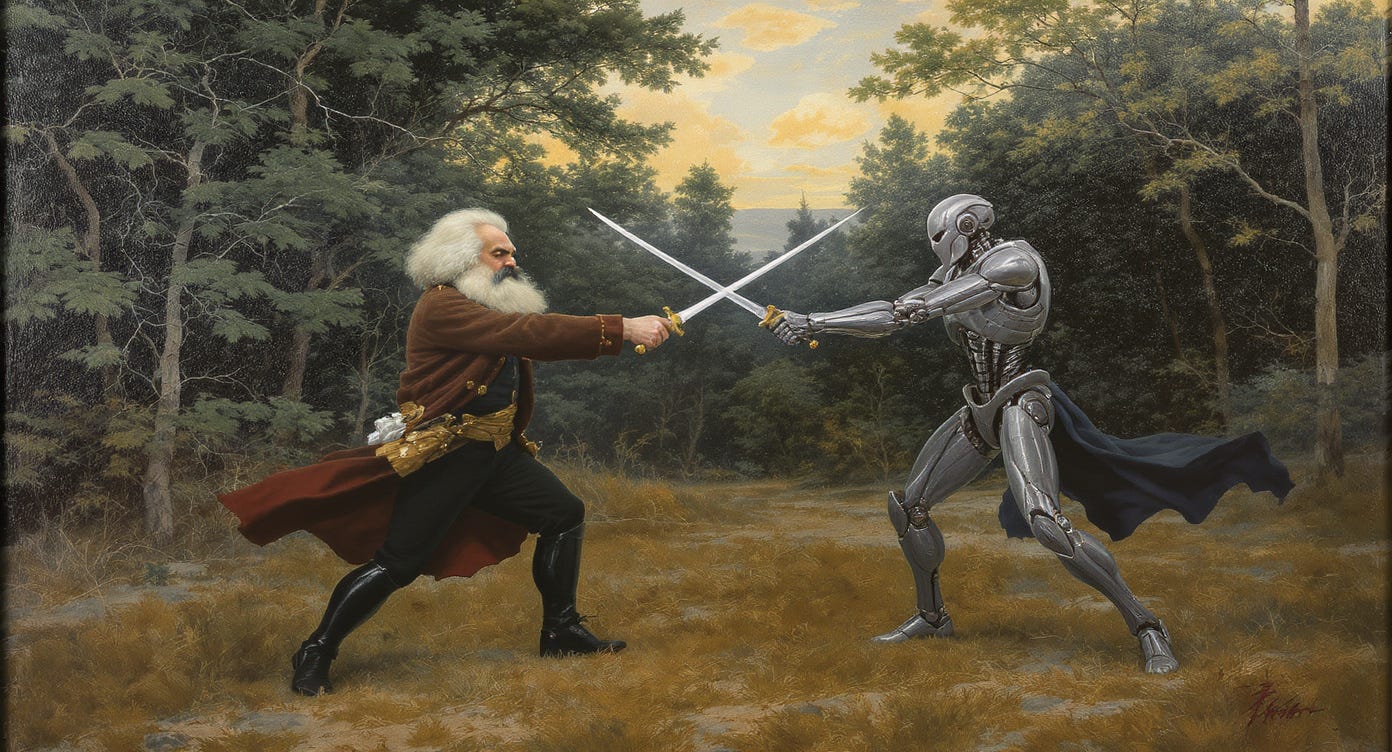
The contemporary dismissal of AI-generated art as "soulless pablum" and "AI slop" represents a fascinating case of theoretical atavism—specifically, an unconscious recapitulation of Marxist value theory transposed into aesthetic discourse. This critique, while superficially addressing questions of authenticity and meaning, ultimately reveals itself as a labor-essentialist position that fundamentally misapprehends both the ontology of artistic value and the historical contingency of creative production methods.
When critics deploy pejoratives like "AI slop," they're engaging in what we might call aesthetic labor fetishism—a direct parallel to Marx's commodity fetishism, but inverted. Where Marx critiqued the obscuration of labor relations behind commodity exchange, these critics fetishize labor itself as the mystical source of artistic authenticity. They've constructed an implicit syllogism: (1) authentic art requires human intentionality manifested through labor; (2) AI art lacks direct human labor; (3) therefore, AI art lacks authenticity and value.
This position unconsciously adopts Marx's distinction between concrete and abstract labor, treating the specific qualitative aspects of human artistic labor as irreducible to any mechanical or computational process. Yet this adoption is peculiarly selective—critics embrace the labor theory's emphasis on human work-time while ignoring Marx's crucial insight that value is socially determined, not intrinsic. They've created a vulgar form of Marxism that even Marx himself would likely repudiate.
The marginalist revolution in economics—initiated by Jevons, Menger, and Walras—demolished the labor theory by demonstrating that value derives from subjective utility at the margin, not embedded labor costs. This shift from objective to subjective value theory should have profound implications for aesthetic philosophy, yet the anti-AI discourse remains trapped in pre-marginalist thinking.
Consider the paradox this creates: critics simultaneously reject neoclassical reductionism to argue that art's value transcends market price while embracing classical reductionism in their insistence that value requires human labor input. They declare that art exists in a unique ontological category where subjective experience matters supremely, yet they ground this special status in the objective fact of human labor expenditure. This theoretical incoherence reveals the position's fundamental retardery.
The anti-AI position commits a category error by conflating the phenomenology of aesthetic experience with the material conditions of production. When we experience profound aesthetic arrest before a work—that glorious moment of luminous stasis—we're not responding to the artist's caloric expenditure or synaptic firing patterns. The aesthetic encounter occurs in what Husserl would call the intentional relation between consciousness and object, a relation entirely independent of the object's causal history.
This becomes evident when we consider edge cases that problematize the labor theory. Found art, aleatory composition, and generative art all minimize or randomize human labor input, yet we don't categorically exclude any of them from art status. The anti-AI position must either reject these established forms—an untenable position—or admit that labor input is neither necessary nor sufficient for artistic value.
The argument against AI art faces a marginal utility problem regarding creative agency. If we accept that art made with traditional tools has value, and art made with power tools has value, and art made with early computers has value, at what precise point does technological assistance negate artistic authenticity? Each incremental advance in creative tools—from pigment-binding techniques to Photoshop's content-aware graphic fill—represents a marginal reduction in direct human labor and an increase in mechanical mediation.
AI does not represent a qualitative break, but rather, but a quantitative progression along this continuum. The insistence on drawing a bright line at AI reveals an essentialist fallacy—the belief that there exists some metaphysical property of "genuine creativity" that admits no degrees. This position cannot withstand serious philosophical scrutiny.
The "AI slop" discourse ultimately functions as aesthetic gatekeeping that attempts to protect established cultural capital in an inevitably futile manner. By assigning human labor as the sole source of artistic value, critics attempt to impose an artificial scarcity on creating art that preserves existing hierarchies of cultural production. For all its dependence upon Marxist thought, it isn't even a true Marxian critique, it's guild protectionism constructed on a Marxist doctrine it doesn’t even understand.
Rejecting the labor theory of artistic value doesn't require embracing naive techno-optimism or denying legitimate concerns about attribution and economic displacement. Rather, it means developing aesthetic frameworks that evaluate art by its capacity to generate meaning, provoke emotional responses, and create beauty, regardless of how it is produced. The alternative is aesthetic theory imprisoned by nineteenth-century economic concepts, perpetually fighting yesterday's theoretical battles as tomorrow's art emerges inexorably around us.
AI does nothing more than take the divine spark of human creativity and enhance it further than anyone had hitherto dreamed possible.
have you been to a modern art exhibit lately?? talk of slop
The functional objection would be better conceived of as the AI being akin to an autistic librarian or an advanced "pocket Asian": it can read everything and mimic, even infuse different sources into an output, but that sort of offering isn't what great artists/writers/poets do, even if it is precisely what their mediocre counterparts do.
Heidegger is of more help than Husserl here: he describes poets as being the ones to name phenomena that have hitherto gone unnamed...and yet they are phenomena that everyone is able to recognize once pointed to and given a name. Similarly, he describes artists as holding up for a people what already matters to them; i.e., artists and writers channel what is already crucially important -- whether it is already recognized as such or is akin to background music that gives societal life its rhythm despite being overlooked or taken for granted.
While our autistic librarian AI friends can mimic or even synthesize what has already been written or created, it does not itself give names to phenomena or channel or hold up what matters for a society. It fundamentally cannot do the latter, as things do not matter to computers the way they do to people.
In a similar vein, even if people are so unfamiliar with great art that they cannot distinguish between great and mediocre art, that essential aspect of mattering imbued in the work of Tolkien or Lewis is not going to manifest in mimicry the way it does in the originals. At the very least, there will be autistic/Asian mishaps requiring fixing.