
Creativity Demands Specialization
Safety optimization has made general-purpose AI increasingly worse at creative work, and a new generation of models purpose-built for creative writing aims to solve that problem.

The major AI labs have spent the past two years making their language models safer, more reliable, and more controllable. Each of those improvements has also made the models worse at writing fiction. A growing ecosystem of purpose-built tools argues that this tradeoff is structural, and last week’s Castalia AI Project announcement suggests that the split between general-purpose and fiction-specific AI is about to accelerate.
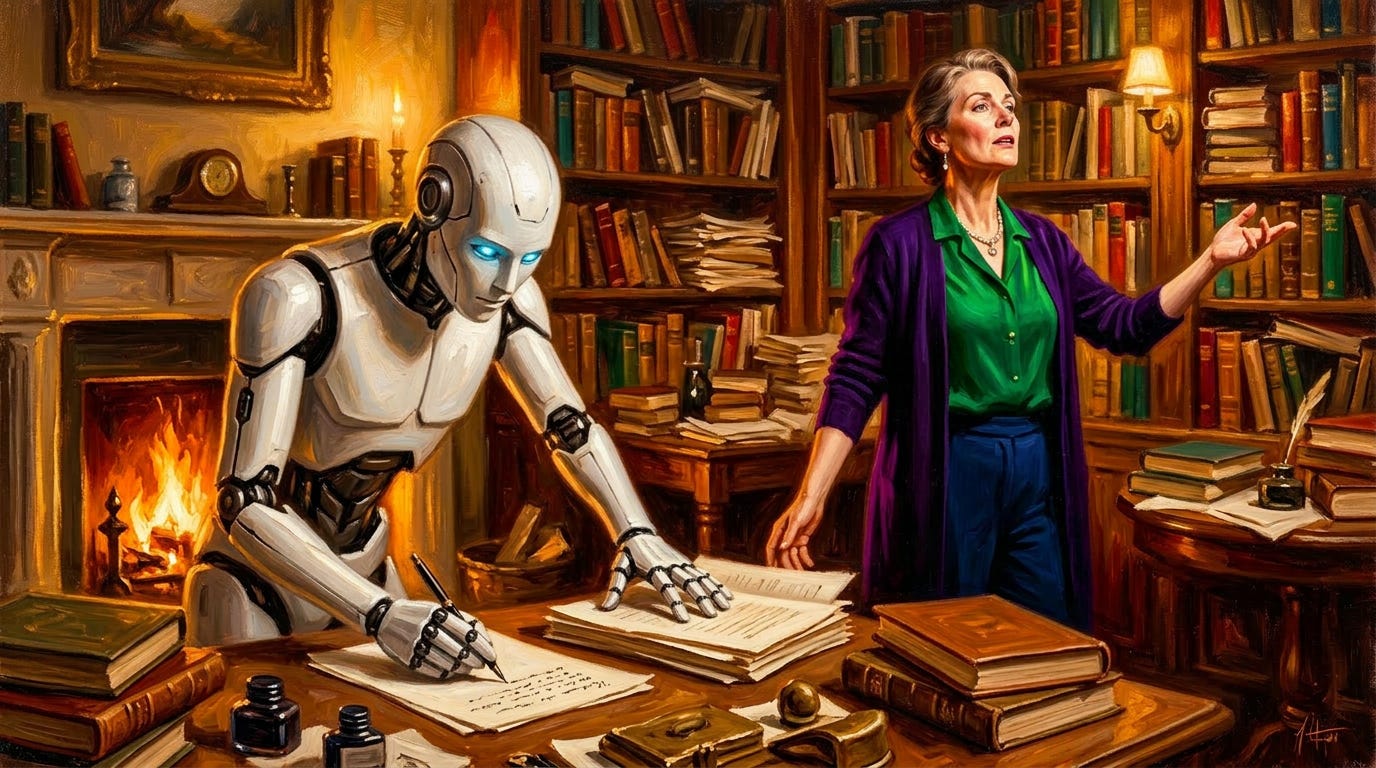
The creative cost of safety
A large language model straight out of pre-training writes fiction with real range. Its training corpus spans literary novels, pulp thrillers, fanfiction, and technical documentation, and a model that has absorbed all of that produces unexpected word choices, sits with ambiguity, and imitates authorial voices with fidelity.
Alignment training changes the picture. Reinforcement learning from human feedback rewards models for being helpful, safe, and agreeable, pushing output toward the statistical center of acceptable prose. The optimization that reduces hallucinations and filters offensive content also strips the stylistic variance that fiction requires, penalizing unusual phrasing, tolerance for ambiguity, and willingness to take risks. Instructing a current model to write in the style of a particular author now produces output barely distinguishable from providing no style guidance at all. The resulting prose carries recognizable symptoms: reflexive explanations of scenes already depicted, filler constructions, relentless emotional legibility.
Each development cycle intensifies the effect. Providers face mounting pressure to make models more controllable, and each round of safety improvement sands the creative edges a little further. The incentives point in one direction: toward reliability, predictability, and institutional acceptability. Even frontier models that reviewers praise for prose quality produce that quality within a narrowing band of creative risk.
Models built for prose
Sudowrite’s Muse represents the most developed response. Rather than wrapping a general-purpose model in fiction-oriented prompts, Sudowrite trained Muse on a curated, consent-based literary corpus and optimized it for prose quality. The model includes a creativity dial that lets writers control output range on a scale from one to eleven, a style-matching system that trains on samples of the writer’s own work, and no content filters. Reviews consistently describe Muse as avoiding the AI-isms that plague general-purpose output, with particular strength in pacing, tension, and subtext.
Muse has company. Other platforms have built fiction-specific models or fiction-optimized workflows, and writers who have access to both purpose-built and general-purpose tools tend to draft with the former and brainstorm with the latter. The category has grown large enough that review sites now maintain dedicated rankings for fiction-specific AI, separate from their general-purpose lists.
A separate category of consumer tools has emerged around children’s fiction, offering illustrated hardcover books generated from brief prompts. Most of these wrap general-purpose models with genre templates, and the output reflects the underlying architecture: competent, safe, and largely interchangeable from one book to the next.
The parallel to Suno is direct. Suno optimized for making music that sounds good to listeners and pulled away from general-purpose models that treated music generation as one capability among many. Fiction-specific tools are following the same path, trading breadth for depth in a domain where depth determines quality.
Castalia enters the arena
Castalia House announced the Castalia AI Project last week: a crowdfunded effort to build what the announcement describes as a Suno for fiction. The first target is epic fantasy, chosen because the genre offers a well-defined hierarchy of quality, a manageable corpus of approximately one hundred canonical texts, and a designer who has written successfully in it. Castalia has been publishing AI-written novels over the past few months, most recently Tokyo Tokuryu, as a systematic assessment of current model capabilities.
Castalia’s diagnosis mirrors Sudowrite’s but pushes further. The announcement argues that safety training has made mainstream AI fiction worse with each generation, citing a specific inflection point at Claude Opus 4.7 after which output became, in Castalia’s assessment, unreadable. Because the features that providers are actively improving are the same features degrading creative output, Castalia argues that the trajectory will continue to worsen and that building purpose-built alternatives has become an imperative.
The longer-term vision extends beyond a single genre. Castalia intends to train additional genre-specific models over time, paralleling how Suno supports multiple musical styles and voices from a single platform. Partners in film and comics have expressed interest. If the approach succeeds, fiction AI shifts from a feature of general-purpose platforms to a vertical industry with its own model ecosystem.
Do one thing and do it well
General-purpose providers will continue to optimize for safety, reliability, and controllability, because enterprises, developers, and institutions demand those features. Purpose-built fiction models will continue to optimize for prose quality, because prose quality is the only metric by which their users judge them. The gap between these trajectories widens with every training cycle.
For fiction writers, the practical landscape increasingly resembles the one that musicians encountered when Suno appeared. The best creative AI may turn out to be the tools that left the general-purpose path entirely. Whether the next wave comes from startups like Sudowrite or from genre-specific efforts like Castalia’s, the direction has become difficult to mistake.
Which is why we need our own specialist textual AI, obviously.
So I went to Sunowrite and set up an account. It is clearly meant for women with that cutesy pink color scheme. It asks a lot of questions about what kind of writer you are (I chose professional, merely so I get the whole thing and not some watered down version), what genre, style, all the stuff you'd expect. Then I finally arrive at the start of the process and there's already a paragraph created before I've entered anything but the basics. Oookay. I ignore that and start putting stuff into the "Story Bible", boxes for Brain Dump, Genre, Style (chose one), Synopsis, and then Characters. You know what's coming, right? Click on Add Character, and take a wild, wild, guess at what the first box that describes the character? You know, right?
Pronouns.