
Claude 4.5 Sonnet
Anthropic announces a newer, smarter Sonnet


Anthropic produces what is easily the best AI for producing text. I’ve used it to successfully complete two books already. And now Anthropic has announced a new version of Sonnet that is, by some measures, 45.5 percent more powerful than Sonnet 4.0.
The new 4.5 release is targeting coding, which should be of interest to a number of the programers here.
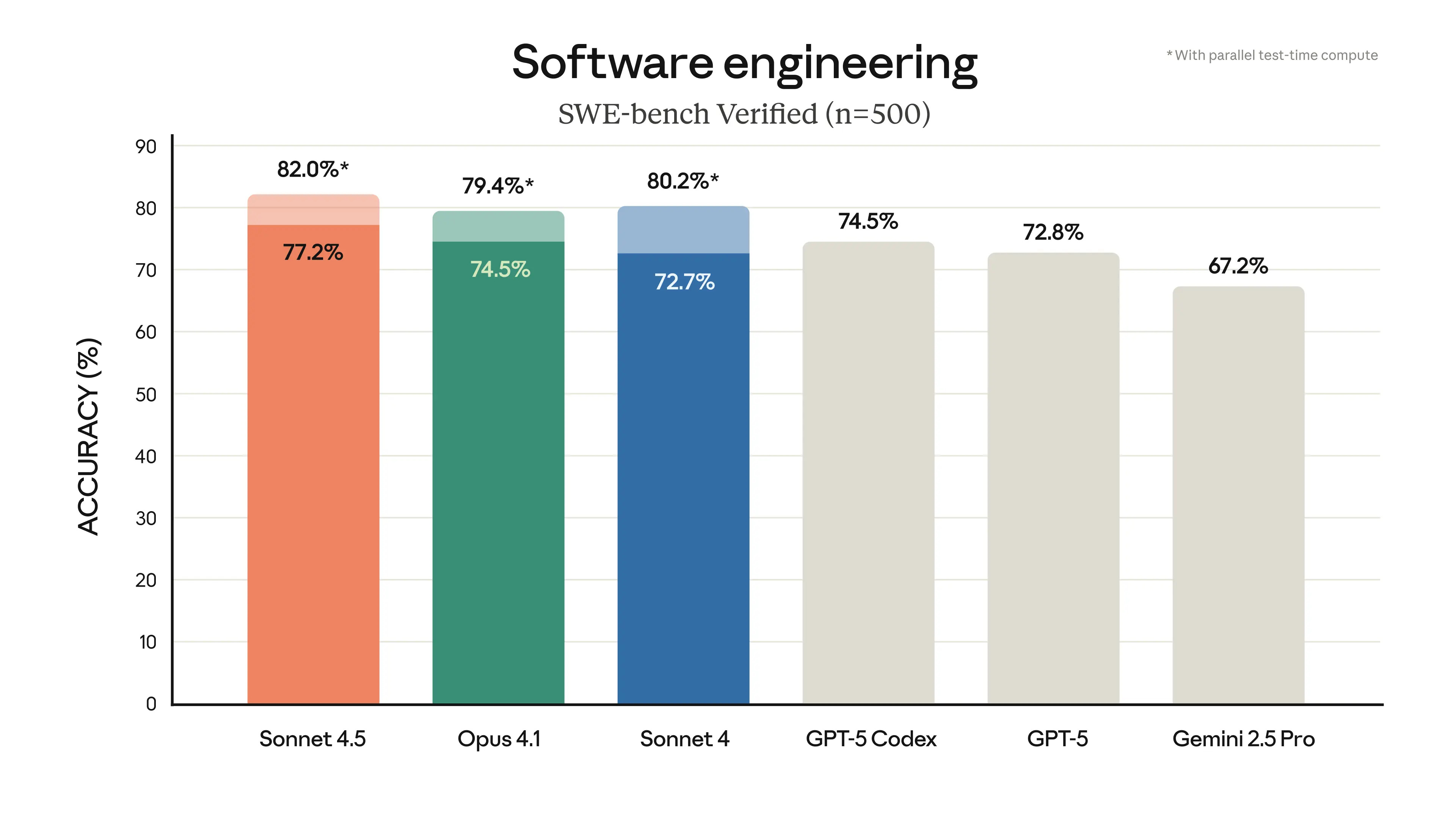
Claude Sonnet 4.5 is the best coding model in the world. It’s the strongest model for building complex agents. It’s the best model at using computers. And it shows substantial gains in reasoning and math.
Code is everywhere. It runs every application, spreadsheet, and software tool you use. Being able to use those tools and reason through hard problems is how modern work gets done.
Claude Sonnet 4.5 makes this possible. We’re releasing it along with a set of major upgrades to our products. In Claude Code, we’ve added checkpoints—one of our most requested features—that save your progress and allow you to roll back instantly to a previous state. We’ve refreshed the terminal interface and shipped a native VS Code extension. We’ve added a new context editing feature and memory tool to the Claude API that lets agents run even longer and handle even greater complexity. In the Claude apps, we’ve brought code execution and file creation (spreadsheets, slides, and documents) directly into the conversation. And we’ve made the Claude for Chrome extension available to Max users who joined the waitlist last month.
We’re also giving developers the building blocks we use ourselves to make Claude Code. We’re calling this the Claude Agent SDK. The infrastructure that powers our frontier products—and allows them to reach their full potential—is now yours to build with.
This is the most aligned frontier model we’ve ever released, showing large improvements across several areas of alignment compared to previous Claude models.
Claude Sonnet 4.5 is available everywhere today. If you’re a developer, simply use
claude-sonnet-4-5via the Claude API. Pricing remains the same as Claude Sonnet 4, at $3/$15 per million tokens.Claude Sonnet 4.5 is state-of-the-art on the SWE-bench Verified evaluation, which measures real-world software coding abilities. Practically speaking, we’ve observed it maintaining focus for more than 30 hours on complex, multi-step tasks. Claude Sonnet 4.5 represents a significant leap forward on computer use. On OSWorld, a benchmark that tests AI models on real-world computer tasks, Sonnet 4.5 now leads at 61.4%. Just four months ago, Sonnet 4 held the lead at 42.2%.
As for what improvements it has to offer writing, I threw the usual test at it. It’s hard to see if there are any actual improvements, but it did do a very serviceable job imitating the style of the specified author. I do note, however, that Sonnet still has a strange fondness for the last name “Chen” which is starting to make me suspect that it is an easter egg of sorts.
The Librarian of Forgotten Sundays
The Dewey Decimal System, Zimmermann reflected while debugging the library’s RFID checkout kludge, was essentially a hash table implemented in base-10 by a nineteenth-century control freak with opinions about metaphysics. The Sunday shift meant he could finally address the PostgreSQL timeout issues without some undergrad asking where to find books about “entrepreneurship” or “finding yourself.”
The collection’s long tail contained some legitimately weird items. Not supernatural weird—Zimmermann had a physics degree and zero patience for that—but statistically anomalous. Books checked out exactly once in 1987. Volumes catalogued with ISBNs that didn’t parse. A card catalog entry, handwritten, referencing a text on “applied chronodynamics” that predated the coining of that term by thirty years.
At 14:37:22 EST, the motion sensors triggered. A woman, mid-twenties, wearing a Caltech hoodie and carrying what appeared to be a homebuilt electromagnetic field detector. She navigated directly to QC174.12—quantum mechanics, interpretational frameworks—without consulting the terminals.
Zimmermann watched via the security feed. She extracted a specific volume, opened it to page 247, and photographed an equation. Then she left.
He pulled the access logs. The book’s last checkout: April 15, 1987. The borrower: Amanda Chen. Same last name as the woman’s visitor badge.
Zimmermann opened a new terminal window and began typing. Whatever this was—family mystery, academic Cold War espionage, or just really dedicated genealogical research—the database held answers. The correlation matrices would tell the story. They always did, eventually.
The PostgreSQL timeout could wait.
The specified author, of course, being Neal Stephenson.
I made two new novel entries on my blog just after the new version came online (Diana part 2 and Arkassia part 2, which are the second parts of two unrelated stories):
https://offmodernity.substack.com/
It appears to be significantly better than before. Furthermore, Claude now has a much longer length limit before having to start a new chat, making it much more convenient to use without having to repeatedly remind it of various things.
I heard that Claude Code can be installed locally. One case study asked Claude to examine and analyze personal journal entries, something I would never upload to ChatGPT. This is an interesting development that opens many possibilities. An installation is apparently fairly straightforward, but it does require one other software program to run.