
China Plants The Flag
China has launched an intergovernmental AI alliance of 29 non-Western nations powered by open-weight models and cutting-edge hardware.

China’s annual World AI Conference in Shanghai has grown from a technology exhibition into a geopolitical event. This year it became an institutional one. Twenty-nine countries signed the founding agreement for a new intergovernmental AI governance body oriented toward the Global South, Xi Jinping addressed the conference in person for the first time, and Chinese companies used the occasion to demonstrate that the country’s AI capabilities now match its governance ambitions.
A new alliance
Last week, representatives from twenty-nine countries signed the agreement establishing the World Artificial Intelligence Cooperation Organization at a ceremony in Shanghai. Chinese Foreign Minister Wang Yi signed on behalf of Beijing. UN Secretary-General António Guterres attended, lending the new body a measure of international legitimacy that a purely Chinese initiative would have lacked. The signing took place on the eve of the annual World AI Conference.
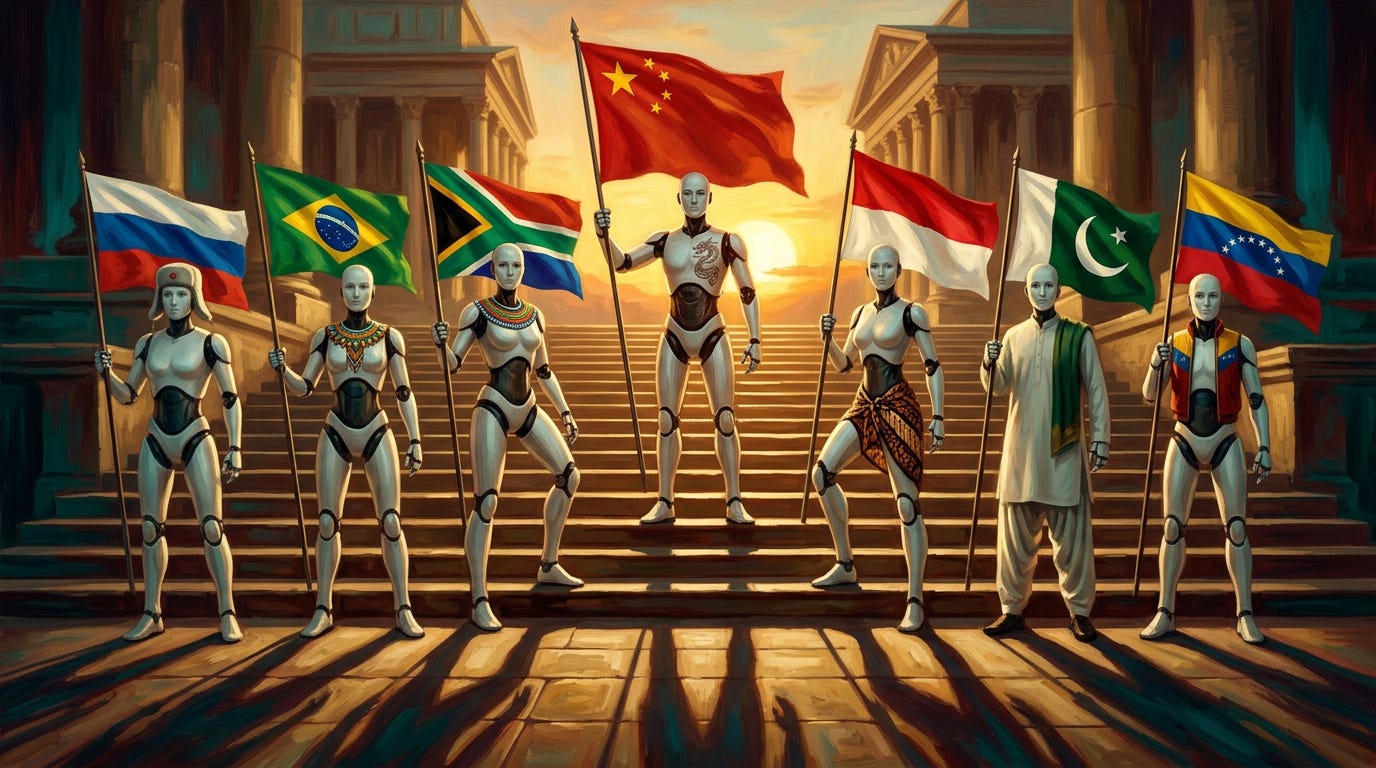
The founding membership spans four continents, with ten African states including South Africa, Ethiopia, and Kenya, twelve Asian signatories including Indonesia, Pakistan, and Malaysia, and Latin American members including Brazil and Venezuela, alongside Russia, Belarus, and Serbia. No major Western democracy joined. WAICO will operate as an independent intergovernmental organization headquartered in Shanghai, the first AI governance body based outside the Western institutional orbit.
A June academic study mapping WAICO against fifteen existing AI governance bodies found that none of the eight Western or like-minded institutions placed development at the center of their agenda. WAICO fills that gap explicitly, targeting countries that define AI governance in terms of compute access, multilingual capability, and deployment for healthcare and agriculture.
The organization traces to July 2025, when Premier Li Qiang proposed a global AI cooperation body at that year’s WAIC. Xi Jinping reiterated the proposal at the APEC summit in October, and China and Zambia formed a joint group at UN headquarters to promote AI capacity-building. A year passed with no country formally announcing membership. Then twenty-nine signed simultaneously. The speed of that transition suggests that considerable bilateral diplomacy happened behind the scenes.
The mission
Xi Jinping addressed the WAIC opening ceremony on July 17, his first in-person appearance at the conference since its founding in 2018. He called on countries to embrace open-source AI, oppose what he described as overstretching national security concepts, and treat AI development as a collective endeavor. Borrowing a Chinese proverb about the limits of solo instruments, Xi described AI development as requiring “a symphony of international cooperation” and objected to any single country claiming dominance over the technology. China pledged 5,000 AI training and research slots for developing nations over the next five years, alongside new cooperation centers targeting ASEAN, the African Union, the Arab League, BRICS, and the Shanghai Cooperation Organisation. Xi also announced plans to deploy China’s Mazu weather-prediction system in thirty countries over five years and framed the country’s core AI economy as exceeding one trillion yuan, roughly $147 billion.
The governance messaging arrived alongside capability demonstrations. Moonshot AI released Kimi K3, a 2.8-trillion-parameter model that the Beijing-based startup describes as the largest open-weight AI system ever built, with benchmarks approaching proprietary frontier models from OpenAI and Anthropic. Moonshot plans to open-source the full weights on July 27. Huawei debuted the Atlas 950 SuperPod, an 8,192-chip AI computing cluster designed to function without US semiconductors. More than 300 AI products made global debuts across the conference’s exhibition floor. These launches arrived despite years of tightening US semiconductor restrictions.