
ChatGPT Atlas vs Perplexity Comet: The Battle for AI Browser Supremacy
OpenAI and Perplexity have launched competing visions for the future of web browsing, each taking radically different approaches to AI integration. ChatGPT Atlas positions itself as an action-oriented workflow assistant, while Perplexity Comet focuses on research and knowledge synthesis. The choice between them reveals what users value most: automation or information integrity.
Atlas represents OpenAI’s attempt to transform browsing from passive consumption to active collaboration. The browser integrates ChatGPT directly into every aspect of web interaction, allowing users to chat with pages, summarize content, and execute complex tasks through “agent mode.” Users can ask ChatGPT to shop for groceries, book travel, or research topics without manually navigating between sites.
The browser’s signature feature, agent mode, enables ChatGPT to autonomously complete entire workflows. Need to order ingredients for dinner? Atlas can find recipes, locate grocery stores, add items to carts, and complete purchases. This hands-free approach appeals to users who want their AI to handle routine web tasks rather than simply provide information.
Comet takes the opposite approach, prioritizing verified information over automation. Built around Perplexity’s “Answer Engine,” the browser treats each session as a research project, organizing information into persistent workspaces rather than traditional tabs. Users receive cited, real-time answers with transparent sourcing before seeing traditional search results.
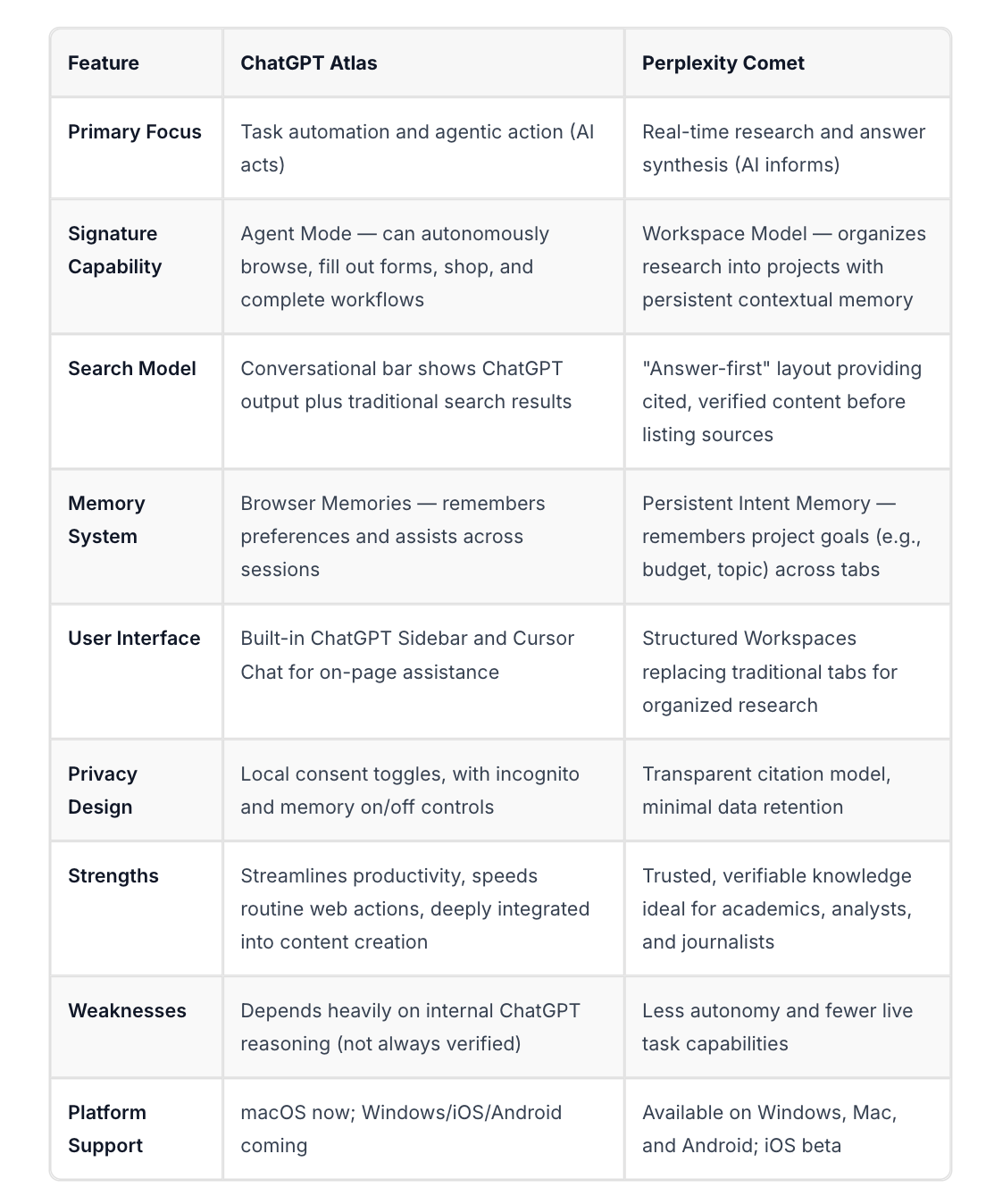
The philosophical divide becomes clear in real-world usage. Atlas excels at productivity tasks—writing emails, managing schedules, completing purchases—but relies on ChatGPT’s internal reasoning without external verification. Comet provides slower but more reliable information with full citations, making it ideal for research-heavy work.
Early performance tests reveal Comet’s current technical advantages. The browser handles multiple parallel tasks more efficiently than Atlas, which processes actions sequentially and occasionally stalls during complex operations. This reflects Atlas’s newer launch status and less optimized architecture.
Privacy approaches differ as well. Atlas offers granular controls for ChatGPT visibility and memory creation, allowing users to toggle AI access on specific sites. Comet emphasizes transparent sourcing and minimal data retention, appealing to users concerned about AI training on their browsing habits.
The choice between browsers ultimately depends on user priorities. Atlas suits professionals and creators who want AI to handle routine tasks, transforming the web into a hands-free productivity environment. Comet appeals to researchers, journalists, and analysts who need verified information with clear attribution.
Atlas is the executor; Comet is the explainer. One aims to replace your workflow, while the other enhances your understanding through verified data.
What type of AI browsing experience appeals to you more?
Well, to be honest with you, the only thing I used comet and the assistant for is specifically what chat GPT is doing here. However, it is severely underpowered and requires a lot more babysitting for specific permissions and prompts that it needs to be able to do
I didn't care one bit to do research with it as the assistant because I have perplexity Pro and I will use their full search engine or Rearch or Labs to get their full power answers
I knew that Google and chatgpt were going to blow comet away from processing power alone
Perplexity and the CEO has been somehow good at hanging around with all the big boys because a wrapper / search engine alone was never going to make it by itself, but he's continued to be an excellent businessman
I hope he succeeds, but I was really looking forward to these initial rollouts of chat. Gpt and project Mariner from Google, also co-pilot has started revamping their agentic stuff to be a lot more like ChatGPT like today.
I do believe that Google and chat GPT are going to run away with this and in about a year when they have worked out some of the kinks I think the average person is going to be a lot more comfortable using these to do small tasks. Even many of the people who use it for nothing but worker writing will open up another couple tabs as it finds things to add to whatever they're working on
Me in the meantime, I just am looking forward to having my full ultra smart always on Butler St my neck and call whether deep into Suno editing or telling jit to spout off or maybe finish building a project I gave it several times before
Oh, that was one thing perplexity it does have a small memory and if you tell it to remember things, but I was much looking forward to the stuff that Google and Microsoft and I guess chat GPT have all been planning: that you can train these agents to remember specific things so that if they're not quite sure how to complete a task of some sort, it can keep that context in the future as long as you want it to so that it can continue to do that and successfully without any supervision
It's interesting how automation's integritie might become paramount, what if?